Summary: For medical clinics in New York, the top AI platforms include Elise AI for automating patient communication and administrative tasks, K Health for benchmarking established AI companies, Intelligencia AI for market mapping, Mednet for clinician support with complex questions, and Standard Practice for voice AI in revenue cycle operations. Each platform addresses specific workflow challenges, helping clinics improve efficiency and focus on patient care.
A front-desk coordinator is juggling three ringing phone lines while four portal alerts appear for prescription renewals. Meanwhile, the back office is stuck on a commercial insurance denial, and nobody has spare time to map out the afternoon schedule.
A medical group under that kind of administrative strain does not need a broad corporate plan for digital change. It needs one recurring bottleneck gone, and medical assistants should not have to split attention across another separate software screen.
Practice administrators comparing the top AI platforms for medical clinics in New York run into a crowded field of venture-funded software. The main buying factor is rarely the engineering stack that looks nicest in an executive deck. Clinical leaders usually do better by pinning down the exact bottleneck that drains staff energy, irritates patients, or pulls physicians away from direct appointments.
The five companies profiled below operate from New York headquarters or keep major bases within the state, and each one targets a different operating need in healthcare delivery. Clinic executives can use this breakdown as a working guide for specific daily bottlenecks, while investors and digital health founders can treat it as a regional map before formal partner evaluations.
1. Elise AI: patient communication and admin work
Elise AI healthcare operations handles patient communication queues and administrative intake paths for outpatient facilities. Corporate records on the organization's healthcare portal place its office at 401 Fifth Avenue, New York, which keeps the company firmly inside the local metropolitan market.
Front-office work feels the strongest effect from this setup, especially when call centers fall behind on inbound questions, appointment changes, and routine follow-up steps. Practice managers who buy in this category usually already know which message queues lag the most, so they choose front-office automation instead of diagnostic algorithms. Practice administrators testing Elise AI should build product demos around one live communication workflow, not an open-ended software tour. Clinic leaders get the best results by naming the exact administrative handoff the software will remove, plus the manual review point that stays with office staff.
2. K Health: an established New York AI company to benchmark
K Health was established in New York in 2016 and keeps corporate headquarters in New York, NY. Documented corporate records confirm its place as an established regional pioneer, even though its public profile does not spell out the exact clinic administrative workflows found in back-office automation tools.
Health system strategists, investors, and startup operators often review K Health when they want a benchmark for mature digital health companies before putting capital into specific medical vendor segments. The company gives medical practice buyers a useful view of how mature venture-funded firms position clinical automation. It does not act like an off-the-shelf utility for clearing billing queues.
Clinic directors should check the platform's concrete integration details before deciding whether its architecture fits facility needs. Public company documentation focuses on broad corporate achievements, so staff need direct talks with the vendor to confirm daily departmental compatibility.
3. Intelligencia AI: a larger New York AI company for market mapping
The Intelligencia AI company profile shows the business was founded in 2017, keeps corporate headquarters in New York with regional offices in Athens, Greece, and has an international workforce of 110 employees. That operating footprint makes the organization a strong candidate for studying established regional technology businesses.
Healthcare founders and private equity researchers watch Intelligencia AI when they assess the maturity of New York technology firms, especially when cross-border operations and headcount shape the review. Outpatient medical centers need tighter boundaries, because public records document company scale rather than a focused tool for front-desk scheduling, ambient medical notes, or claims collections.
Practice purchasers should center their evaluation on concrete operational boundaries. Staff need to identify which specific department member uses the system, which clinical or business decision changes, and what patient records the software needs before a trial gets scheduled.
4. Mednet: clinical questions backed by literature and physicians
The Mednet Y Combinator profile says the startup entered the accelerator in W2017, has 35 employees in New York City, and helps physicians with hard medical decisions by combining machine learning, published research, and the judgment of practicing doctors. Mednet is built for clinical diagnostic support. It is not aimed at patient intake or front-desk chatter.
Physician practices get the most value from it when doctors are spending too much of their own time reading clinical literature for complex cases. The platform mixes computational analysis with peer-reviewed medical journals and physician guidance. It fits doctors who are working through difficult diagnostic puzzles, not managers trying to cut down incoming call volume.
Physicians should test Mednet against a selected set of older patient cases that led to long specialist consultations. A structured review shows whether practitioners get faster clarity on treatment paths, while leaving independent physician responsibility for every care decision in place.
5. Standard Practice: voice AI for revenue cycle teams
The Standard Practice company profile explains that the company builds voice AI for healthcare organizations, with a focus on automating phone work for revenue cycle teams. CB Insights records show that Standard Practice started operations in 2021 and keeps its headquarters in New York, New York. Outpatient groups get the most value from this voice application when medical billers lose productive hours to manual calls with commercial payers. The company is aimed at one clear operational pain point, not at all-purpose clinic software. The main buyer is a revenue cycle director or finance leader, not a clinical medical director.
Billing supervisors should judge Standard Practice by putting it against one claims collection queue, such as repeated prior authorization checks or open payer status questions. The key measure is whether automated voice agents close open accounts receivable faster without adding new documentation errors for administrative staff.
How should a New York clinic choose among them?
A New York clinic should choose by the workflow it needs to fix first: patient messaging points to Elise AI, physician diagnostic research to Mednet, and revenue cycle phone work to Standard Practice.
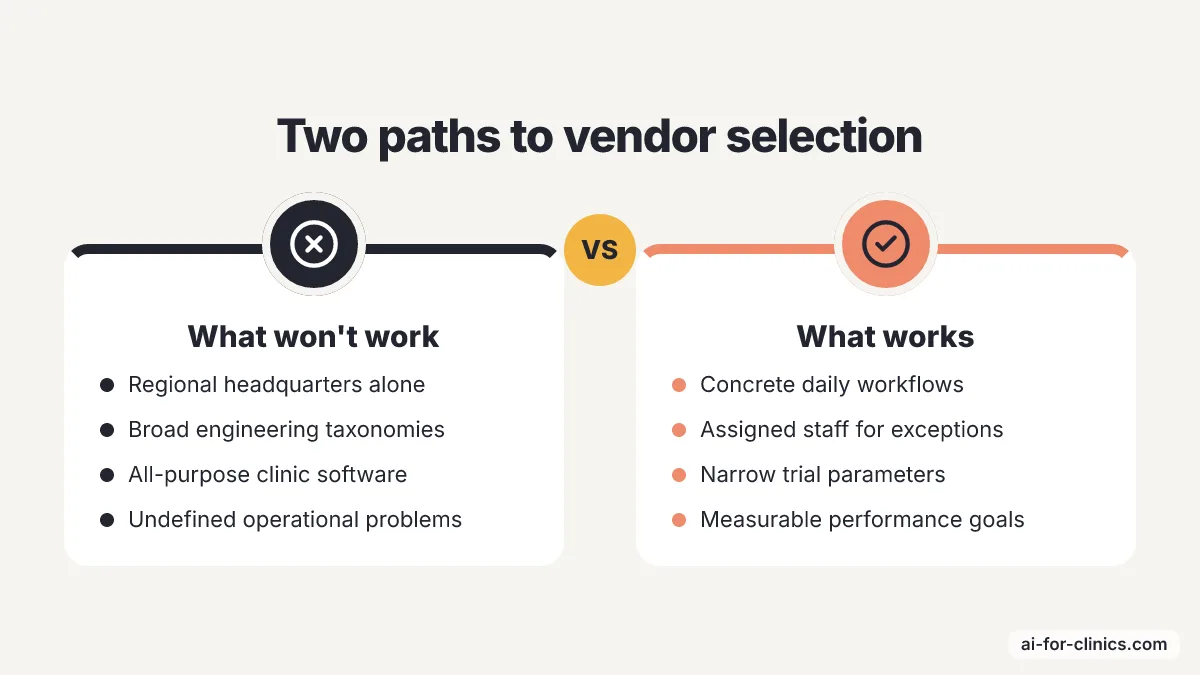
Geographic location provides a useful preliminary filter during software procurement, but regional headquarters alone cannot resolve internal operational problems. While regional proximity simplifies executive meetings and vendor support, healthcare providers must purchase systems based on concrete workflows: patient messaging, physician diagnostic research, or revenue cycle management.
AI for Clinics is Clinsight's directory of U.S. healthcare startups, built for founders, investors, and healthtech researchers who need state and vertical filters before vendor calls. The directory illustrates that a New York address represents a sourcing parameter rather than automatic proof of day-to-day clinical utility.
An independent medical facility like Silver Creek Family Dental represents a typical operational customer rather than a software platform in these comparisons. Facilities of this type serve as practical benchmarks for operational buyers, demonstrating that procurement conversations must focus on daily office requirements instead of broad engineering taxonomies.
Medical administrators can use a practical four-part framework prior to scheduling software demonstrations:
- Identify the struggling operational queue in plain office terms. Escalating patient phone calls point toward patient communication platforms, diagnostic ambiguity indicates clinical decision systems, and lengthy billing calls require revenue cycle automation.
- Establish which clinical or office staff member reviews system output. Healthcare facilities require an assigned individual for exception handling, because unsupervised automation pushes unaddressed tasks into secondary administrative inboxes.
- Determine whether current electronic health record software already provides the necessary capabilities. FierceHealthcare reported in February 2026 that the Epic AI Charting release introduced automated clinical note drafting and order suggestions extracted from doctor-patient dialogue, reshaping procurement economics for organizations running Epic.
- Restrict trial implementations to narrow parameters. An initial trial should concentrate on a single administrative channel, a single team of staff, and one baseline performance metric that workers already track.
Regional healthcare organizations must track ambient documentation trends closely following major clinical deployments in 2026. PYMNTS reported in September 2026 that the SUNY Downstate ambient scribe pilot involved 50 physicians across family medicine, internal medicine, cardiology, and the emergency department, completing over 900 encounters since May.
PR Newswire documented in April 2026 that the Niagara Falls, NY-based developer of PrognoCIS announced the PrognoAI global launch announcement, adding an ambient scribe alongside automated summaries covering previous visits, medical diagnoses, and prescribed treatments.
Patient-facing software requires rigorous regulatory checks whenever pediatric patients might access digital chat channels. IAPP reported in October 2026 that Governor Hochul enacted the New York youth chatbot law, restricting companion chatbots for minors across 12 regulated subjects starting January 1, 2027. Outpatient organizations offering digital triage or mental health support channels must audit these compliance boundaries before introducing chat tools to patient portals.
The obvious recommendation fails for one distinct group of medical facilities: a practice that cannot define its primary operational breakdown should postpone purchasing artificial intelligence software entirely. Refining manual task assignments, updating telephone routing menus, or enforcing standardized intake templates delivers faster cost savings until managers identify the precise job to automate, assign an employee to review exceptions, and set measurable performance goals.
Digital health founders researching top AI platforms for clinics in Georgia should apply this same workflow-driven methodology rather than replicating a Northeast vendor shortlist across regional markets. Healthcare venture funds examining regional technology distribution should isolate geographical location from clinical capability, assessing operational niches through research guides such as AI healthcare startup ideas and comparative corporate structures outlined in vertical AI startup examples.
Next step: write a one-page workflow brief before vendor calls
Draft a single-page workflow description before initiating conversations with prospective software vendors. This document must record the exact operational delay, the designated staff member handling the task, the transaction volume disrupting office routines, the mandatory human review protocol, and the performance baseline required to justify future software investment.
Investment analysts and healthtech founders can apply this identical analytical framework in reverse: determine the specific clinical friction point a company resolves, then grade competing firms on operational depth rather than promotional terminology. Practice managers must pause the procurement cycle whenever a vendor fails to substantiate day-to-day utility. When an account executive cannot illustrate how a product relieves a documented internal task, the required response is pausing further sales pitches to establish clearer operational parameters internally.
Frequently Asked Questions
What are the best AI platforms for automating patient communication in New York medical clinics?
Elise AI is built for automating patient communication and administrative tasks in New York medical clinics. It helps manage patient communication queues and administrative intake paths, particularly benefiting front-office operations when call centers fall behind.
Which AI platform should New York clinics consider for benchmarking established AI companies?
K Health is an established AI company in New York that clinics can use as a benchmark for mature digital health companies. It provides a view of how mature venture-funded firms position clinical automation, although it does not directly offer tools for specific clinic administrative workflows.
How can Intelligencia AI help New York medical clinics with market mapping?
Intelligencia AI, headquartered in New York, is useful for studying established regional technology businesses. It is particularly valuable for healthcare founders and private equity researchers assessing the maturity of New York technology firms, though clinics need to focus on specific operational boundaries when evaluating its use.
What AI platform supports New York physicians with complex clinical questions?
Mednet is designed to assist physicians in New York with complex clinical questions by combining machine learning, published research, and physician judgment. It is best suited for doctors who need support with difficult diagnostic puzzles, rather than for patient intake or front-desk operations.
Which AI platform is recommended for automating revenue cycle operations in New York clinics?
Standard Practice is a fit for automating revenue cycle operations in New York clinics. It focuses on voice AI to help revenue cycle teams manage phone work, particularly useful for billing supervisors dealing with claims collection queues and reducing manual calls with commercial payers.
Related reading
- AI Healthcare Startup Ideas: A 2026 Guide for Founders
- Top 5 US Startups in Vertical AI for Dentists & Lawyers
- Word of Mouth Healthcare AI Marketing in 2026
- How to Find a Technical Co-Founder for Clinic AI Startup
- The AI Has Already Rewritten Medical Search. Most Practices Are Still Drafting the Old Playbook.
- 8 Best Tools to Track AI Clinic Recommendations in 2026
Where to go next
Sources
- Elise AI – AI for Healthcare Operations
- Intelligencia AI
- Mednet (Y Combinator profile)
- Standard Practice (CB Insights profile)
- IAPP: New York Governor Hochul signs youth AI chatbot safety law (S9051-B/A10379-C, Chapter 368)
- PYMNTS: SUNY Downstate (Brooklyn) deploys Altera's Sunrise Thread AI ambient scribe