Summary: The best AI solutions for medical clinics in Texas focus on specific operational needs and still need to be checked against state regulations. Top options include Lumentra AI for voice intake, CTGS for custom software, Medico Growth for practice automation, Alliance Tech for after-hours calls, Justin Healthcare AI for consultant-led implementations, and Taction Software for regulated healthcare apps. Each solution targets a different clinic function, and each one should be checked for system integration and Texas compliance before a pilot.
The vendor demo with the longest feature list usually gets the nod. That advice fails for Texas medical clinics because an AI product now has to fit the workflow, the EHR, and state-level patient disclosure obligations before the first pilot is worth running.
The better test is narrower: choose the AI solution that owns one clinic job well, then prove that it can operate inside Texas healthcare rules. In January 2026, the Texas Office of the Attorney General says the Texas Responsible Artificial Intelligence Governance Act requires clear patient disclosure when AI is used in relation to healthcare services or treatment, and the Texas Legislature's SB 1188 says electronic health records must stay in the United States or a U.S. territory.
AI for medical clinics should not be bought as a novelty layer. The strongest Texas shortlist starts with the operational bottleneck, such as phone intake, documentation, billing, custom app development, or patient communication, then filters for healthcare compliance and implementation depth.
1. Lumentra AI: best for voice intake tied to clinic systems
Lumentra AI medical-clinic voice assistants builds HIPAA-compliant AI voice assistants for medical practices, specialty clinics, and healthcare networks across Plano, Dallas, and DFW. The fit is strongest for clinics where missed calls, intake routing, and front-desk capacity create a measurable access problem.
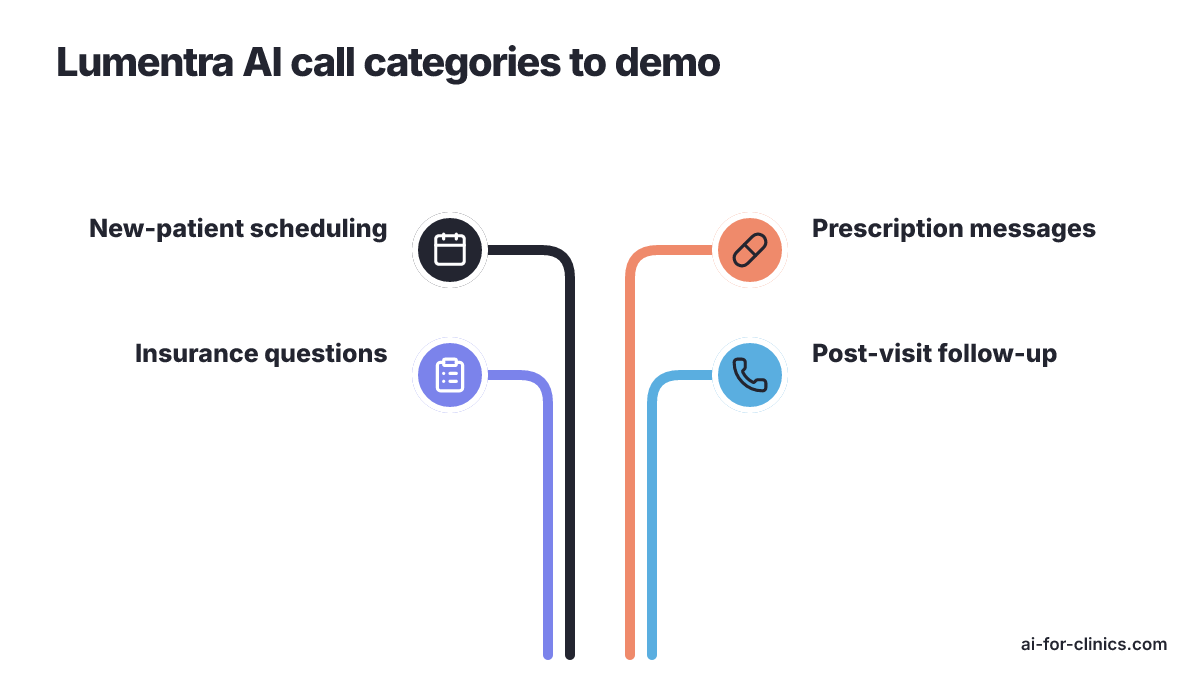
Lumentra AI suits practices that already know which phone workflows are breaking. A clinic evaluating the product should bring call categories to the demo, such as new-patient scheduling, prescription messages, insurance questions, or post-visit follow-up, because a voice assistant only proves value when the handoff rules are specific.
The integration point matters more than the voice quality in a Texas clinic. A system that talks well but cannot write back to the clinic's scheduling or record workflow leaves staff reconciling messages at the end of the day, which moves the backlog instead of removing it.
2. CTGS: best for custom healthcare software builds
CTGS healthcare software development provides custom software services, HIPAA-compliant solutions, and mobile app development for hospitals and clinics across Texas. The best fit is a clinic group, hospital team, or health-tech founder that has a defined workflow problem and needs software built around existing operations.
CTGS belongs on the shortlist when off-the-shelf automation does not match the care model. Custom development is slower to specify than buying a single-purpose AI tool, but it gives the buyer more control over user roles, data flow, mobile experience, and how the software fits into clinical operations.
A clinic should not open a CTGS conversation with a vague request for AI. A better first brief names the workflow, the users, the protected health information involved, the system that stores the source of truth, and the decision that the software is allowed to support.
3. Medico Growth: best for practice automation and patient communication
Medico Growth AI automation services brings AI automation to healthcare practices, with solutions for repetitive tasks, patient communication, and day-to-day clinic operations from Houston. The product direction suits practices that need administrative relief before they need a new clinical system.
Medico Growth is a practical candidate for clinics where staff spend too much time on repeat communication. The buyer should define the first automation in plain language, such as reminders, follow-up messages, intake prompts, or internal task routing, because broad automation projects become difficult to judge when every department wants a different outcome.
The trade-off is scope control. A practice automation project has to be limited enough that staff can test it during normal hours, yet useful enough to remove a repeat task from the daily queue.
4. Alliance Tech: best for after-hours calls and booking
Alliance Tech healthcare AI automation builds AI automation for healthcare clinics in Texas. It picks up calls, handles messages, and sets appointments 24/7. The company works with dental and med spa clinics in Houston and across the state. Its strongest use case is a clinic whose phone line gets jammed once staff head home.
Alliance Tech fits best when a buyer has heavy intake volume and only a short menu of visit types. Dental and med spa clinics match that setup well. Many requests can be sorted by service, open times, urgency, and booking rules before a person needs to step in.
A clinic should test this category against real call transcripts, not polished scripts. The question is whether the AI books the right slot, captures the right message, and sends the cases that should stay with a human.
5. Justin Healthcare AI: best for consultant-led implementation
Justin Healthcare AI practice automation is a healthcare AI consultant that says it has helped 500+ medical practices across 28 specialties install HIPAA-compliant AI for documentation, scheduling, billing, and patient communication. The best fit is a practice that wants help choosing and rolling out automation across several functions instead of buying a single tool.
Justin Healthcare AI helps when the problem reaches across departments. Documentation, scheduling, billing, and patient communication involve different staff groups. The implementation plan has to set priorities before vendors or prompts enter the discussion.
The consulting model takes time up front because the clinic has to map processes and agree on decision rights. The payoff is a cleaner rollout when leadership does not yet know which AI use case should come first.
6. Taction Software: best for regulated healthcare apps
Taction Software healthcare AI apps develops secure, intelligent, and scalable healthcare apps for hospitals, clinics, and digital health startups across Texas, and it cites 20+ years in healthcare IT and AI experience tied to HIPAA and HITECH requirements. The best fit is an organization building a product, portal, or app rather than adding a narrow automation to an existing clinic workflow.
Taction Software belongs in conversations where the finished product has to serve users beyond one front desk. Hospitals, clinics, and digital health startups need different permission models, audit expectations, and data flows than a single-site practice automation.
A buyer should ask Taction Software to separate the AI layer from the health app architecture during scoping. That distinction helps founders and clinic operators judge what is model behavior, what is software infrastructure, and what must be governed under healthcare privacy requirements.
Texas clinic AI vendors compared at a glance
| Vendor | Best for | Texas presence named in this article |
|---|---|---|
| Lumentra AI | Voice intake tied to clinic systems | Plano, Dallas and DFW |
| CTGS | Custom healthcare software builds | Hospitals and clinics across Texas |
| Medico Growth | Practice automation and patient communication | Houston |
| Alliance Tech | After-hours calls and booking | Houston and across the state |
| Justin Healthcare AI | Consultant-led implementation across several functions | Houston practice automation page |
| Taction Software | Regulated healthcare apps and portals | Hospitals, clinics and startups across Texas |
How should a Texas clinic choose among AI vendors?
Start with the clinic job that is already costing time, then match the vendor category to that job. Voice assistants fit phone intake, automation shops fit repeat administrative tasks, consultants fit multi-department rollouts, and custom software teams fit workflows that cannot be handled by a standard product.
Texas buyers should make compliance a first-round filter, not a contract appendix. In January 2026, TRAIGA requires a provider using AI in relation to healthcare services or treatment to give patients a clear and conspicuous disclosure no later than the date the service is first provided, according to the Texas Attorney General AI rights page. A vendor that cannot explain where that disclosure appears in the patient journey is not ready for a live clinical rollout.
Texas buyers should ask where patient records are stored before asking about model performance. In January 2026, Texas SB 1188 prohibits electronic health records from being stored outside the United States or a U.S. territory, while offshore access remains permitted with appropriate safeguards under the SB 1188 statute text. A clinic using AI-enabled systems should get the storage answer in writing because the legal issue sits with the record location, not the vendor's marketing language.
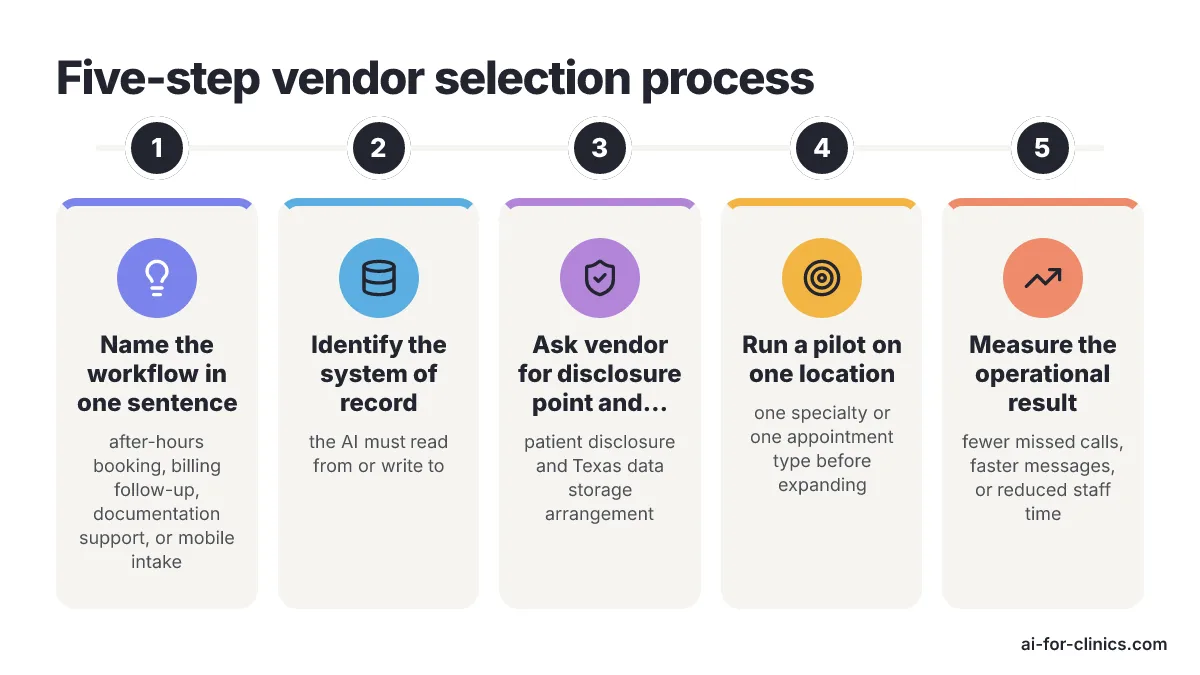
A practical selection process has five steps:
- Name the workflow in one sentence, such as after-hours booking, billing follow-up, documentation support, or mobile intake.
- Identify the system of record the AI must read from or write to, because disconnected automation creates manual reconciliation.
- Ask the vendor to show the patient disclosure point and the EHR storage arrangement for Texas use.
- Run a pilot on one location, one specialty, or one appointment type before expanding to the whole clinic.
- Measure the operational result that made the project worth buying, such as fewer missed calls, faster message handling, or reduced staff time on repeat tasks.
One exception belongs in the first buying meeting: a clinic replacing only an after-hours phone line should not start with a custom software build. A narrow voice or booking automation is easier to test, cheaper to govern, and more likely to show whether patients will accept AI in that interaction.
A practice such as McCall Dental Care is a useful contrast because it is a small dental practice led by Dr. Ryan Speirs that focuses on comprehensive dentistry aimed at renewed health and patient confidence. A clinic evaluating AI vendors should protect that care promise by automating the administrative friction around the visit, not by handing off clinical judgment without a governance plan.
California and nationwide clinic searches need the same workflow-first logic, but not the same legal checklist. A buyer looking for AI solutions for medical clinics in California, or for clinics across multiple states, should keep the same vendor categories and replace the Texas disclosure and storage checks with counsel's state-by-state requirements before comparing prices.
Investors and founders should read these vendors differently from clinic operators. AI for Clinics is Clinsight's directory of U.S. healthcare startups, so the useful market-intelligence question is which workflow each company owns, which buyer it serves, and whether its compliance posture matches the state where it sells.
Founders benchmarking a similar company can pair vendor research with clinical AI investor due diligence, especially when a product claims traction across clinics but still needs proof that implementation repeats. Researchers mapping adjacent care models can compare startup positioning through profiles such as 123 Virtual Clinic and 2020 Vision Care before deciding whether a Texas vendor is competing in access, operations, or specialty care infrastructure.
Conclusion: start with a one-page buying brief
Pick the first vendor conversation by workflow, not by AI capability. A Texas clinic that needs better call coverage should start with a voice or booking automation demo, while a clinic building a new patient-facing product should speak with a healthcare app or custom software team.
The first action is a one-page buying brief. Write the workflow, users, systems touched, patient disclosure point, record storage requirement, and pilot metric before scheduling demos. That brief takes less effort than a failed rollout and gives every vendor the same test. The advice stops at vendor selection: final contracting, legal review, and clinical governance need the clinic's counsel, compliance lead, and operational owner in the same room.
Frequently Asked Questions
What are the best AI solutions for medical clinics in Texas?
The best AI solutions for Texas medical clinics include Lumentra AI for voice intake, CTGS for custom software, Medico Growth for practice automation, Alliance Tech for after-hours calls, Justin Healthcare AI for consultant-led implementations, and Taction Software for regulated healthcare apps. Each solution targets specific operational needs, and each should be checked against Texas disclosure and record-storage rules.
How does Lumentra AI help with voice intake in Texas clinics?
Lumentra AI builds HIPAA-compliant voice assistants for medical practices, focusing on improving phone workflows like new-patient scheduling and prescription messages. It integrates with clinic systems to ensure messages are properly routed, reducing the backlog of calls and improving access.
Why choose CTGS for custom healthcare software in Texas?
CTGS is ideal for clinics needing custom software built around existing operations. It offers HIPAA-compliant solutions tailored to specific workflow problems, providing more control over user roles and data flow compared to off-the-shelf automation tools.
What makes Medico Growth suitable for practice automation in Texas?
Medico Growth is designed for practices needing administrative relief through AI automation. It helps with repetitive tasks and patient communication, allowing clinics to define specific automations like reminders and follow-up messages, which can be tested during normal hours.
How does the Texas Responsible Artificial Intelligence Governance Act affect AI use in clinics?
The Texas Responsible Artificial Intelligence Governance Act requires clinics to provide clear patient disclosure when AI is used in healthcare services. This ensures transparency and compliance with state regulations, making it crucial for clinics to choose AI vendors that can demonstrate where disclosures appear in the patient journey.
Related reading
- Investor Due Diligence Questions for Clinical AI Startups
- How to Find a Technical Co-Founder for Clinic AI Startup
- AI Healthcare Startup Ideas: A 2026 Guide for Founders
- AI Healthcare Business Opportunities in 2026: Key Trends
- The AI Has Already Rewritten Medical Search. Most Practices Are Still Drafting the Old Playbook.
- 7 Best AI Marketing Tools for Med Spas in 2026