Summary: Healthcare clinics should prioritize AI tools that enhance documentation and workflow efficiency. Leading options include VELMENI AI for unified dental imaging, claims, and voice workflows, ScribeMD for rapid clinical note generation, Vero for institutional-level documentation validation, CureMD for ambient transcription, Medwriter.ai for straightforward note automation, iScribe Health for specialty coding support, and Heidi Health for comprehensive workflow management. These tools address key clinic needs, from speeding up note-taking to managing administrative tasks.
A clinician wraps up a visit, speaks the plan, and the next patient is already being brought back before the note gets signed. At the front desk, a referral request is waiting. The billing queue wants codes that someone can actually use. Then the clinic finds out whether the AI tool removed work, or just pushed that work onto another screen.
The real choice is not whether artificial intelligence belongs in healthcare clinics. The harder choice is which part of the workflow should get it first: clinical notes, specialty documentation, claims help, imaging, or the administrative tasks that gather around every patient visit. This article takes a narrow view on purpose. Most clinics should look at documentation and workflow AI before they chase wider automation, because notes, coding, and follow-up tasks sit closest to daily capacity. Diagnostic and monitoring AI belong in a separate buying process, especially when FDA authorization affects the decision.
Which AI tools should clinics compare first?
AI for Clinics is Clinsight's directory of U.S. Healthcare startups, built for founders, investors, and health-tech researchers tracking the clinical AI market. The site's U.S. Healthcare startup directory is most useful when a clinic tool decision also raises a market question, such as which vendors are building around the same workflow.
1. VELMENI AI dental platform: unified dental imaging, claims, and voice workflows
VELMENI AI belongs at the top of the shortlist for dental clinics because the platform is described as the industry's only unified AI platform that combines 2D/3D imaging, claims, and voice in one FDA-cleared dental system. The better fit is not a general scribe replacement. It is a dental workflow platform for AI X-ray and imaging analysis, 3D/CBCT analysis and verification, voice-driven perio charting, AI-assisted insurance claims support, cone beam reporting, and immersive VR 3D/CBCT visualization for patient education.
2. ScribeMD AI scribe: fast notes for high-volume clinics
ScribeMD is an AI-powered medical scribe for clinics that want the shortest route from encounter audio to a usable clinical note. The company says ScribeMD is trusted by 30,000+ physicians and generates clinical notes in under 30 seconds. Speed is the clearest reason to place it high on a documentation shortlist.
The best fit is a clinic where clinicians already know what the note should say, but manual typing and after-visit cleanup slow the day down. ScribeMD's stated value is not specialty coding or imaging. Its promise is rapid clinical note generation, so the review should focus on note accuracy, clinician editing time, and how the output fits the clinic's charting habits.
A fast note only helps if the clinic has a review step before the note reaches the record. A pilot should compare the signed note with the clinician's usual documentation standard, not with a blank page.
3. Vero clinical documentation platform: institutional reference depth
Vero is a clinical AI documentation platform with a user list that matters to buyers who want institutional validation before a pilot. Vero says it is used by clinicians at Cleveland Clinic and Stanford Medicine, along with Harvard Medical School, Johns Hopkins School of Medicine, Mass General, Mount Sinai, and UCLA Health. Vero suits clinics that want proof of use in complex clinical settings before asking clinicians to change documentation habits. For clinics comparing AI tools in California, Vero's cited users include Stanford Medicine and UCLA Health, which gives California-based evaluators a relevant reference point without turning the decision into a local procurement shortcut.
The strongest reason to evaluate Vero is not the appearance of a famous institution on a website. The reason is that institutional use changes the questions a clinic can ask during diligence: what specialties use it, how clinicians review notes, and whether the documentation output holds up under real clinical complexity.
4. CureMD AI medical scribe: ambient documentation for instant transcription
CureMD AI Medical Scribe is a documentation tool for clinics that want ambient listening to capture the patient visit and turn it into clinical documentation. CureMD says its AI Medical Scribe uses ambient listening technology to provide instant transcription and documentation. CureMD fits clinics where most of the note is already said during the visit. It belongs on a shortlist when clinicians want less typing while they are in the room, and the clinic wants documentation drawn from the natural conversation instead of from dictation after the patient leaves.
The buying question is whether instant transcription gives the clinic the structure it needs. A transcript by itself is not a signed note. A practical pilot should track how much editing the clinician still does after CureMD captures the encounter.
5. Medwriter.ai clinical documentation: simple note automation for clinicians
Medwriter.ai offers AI for medical professionals who want automated documentation without turning the tool into the center of the clinical workflow. The company says Medwriter.ai helps clinicians save hours on clinical notes so they can focus on patient care with automated documentation. Medwriter.ai suits clinics that want a direct documentation aid rather than a broader administrative platform. The product positioning is plain. It cuts note work, so clinicians spend less time writing and more time in the patient-facing part of care.
The right test for Medwriter.ai is whether the tool fits the clinician's normal language and note style. A clinic should not look only at whether a note appears. It should ask whether the clinician trusts the note enough to sign it after a short review.
6. iScribe Health specialty scribe: specialty notes with coding support
IScribe Health is an ambient AI medical scribe aimed at specialty practices that need more than a general visit summary. IScribe says its system writes claim-ready notes and AI-assisted E&M codes for 4,000+ providers daily, which makes coding support part of the product's stated value. IScribe belongs on the shortlist for specialty groups where documentation quality affects both clinical continuity and the revenue cycle. Claim-ready notes and AI-assisted E&M codes make the tool especially relevant when clinicians and billing staff already spend time reconciling documentation after the visit.
The trade-off is operational responsibility. Coding assistance still needs human review, so the clinic should define who accepts or rejects the suggested E&M code before the pilot begins.
7. Heidi Health clinical workflow: notes plus surrounding admin work
Heidi Health, built by Heidi Health Pty Ltd, transcribes consults, generates structured notes, and moves clinical workflow tasks around the visit. Heidi suits clinics that want documentation support but are also looking at the administrative work that follows a consultation. Heidi's roadmap matters because the product is moving beyond note generation. In September 2026, Heidi announced Heidi II clinical AI agents, a version designed to act on administrative work around each patient visit, with connectors that pull appointment lists, answer EHR questions, and manage clinical mail.
The fit is strongest when the clinic's bottleneck is the note, the referrals, the follow-up scheduling, and the mail that pile up after the encounter. Heidi should be evaluated as a workflow tool. That broader scope changes both the upside and the implementation burden.
How the seven clinic AI tools differ
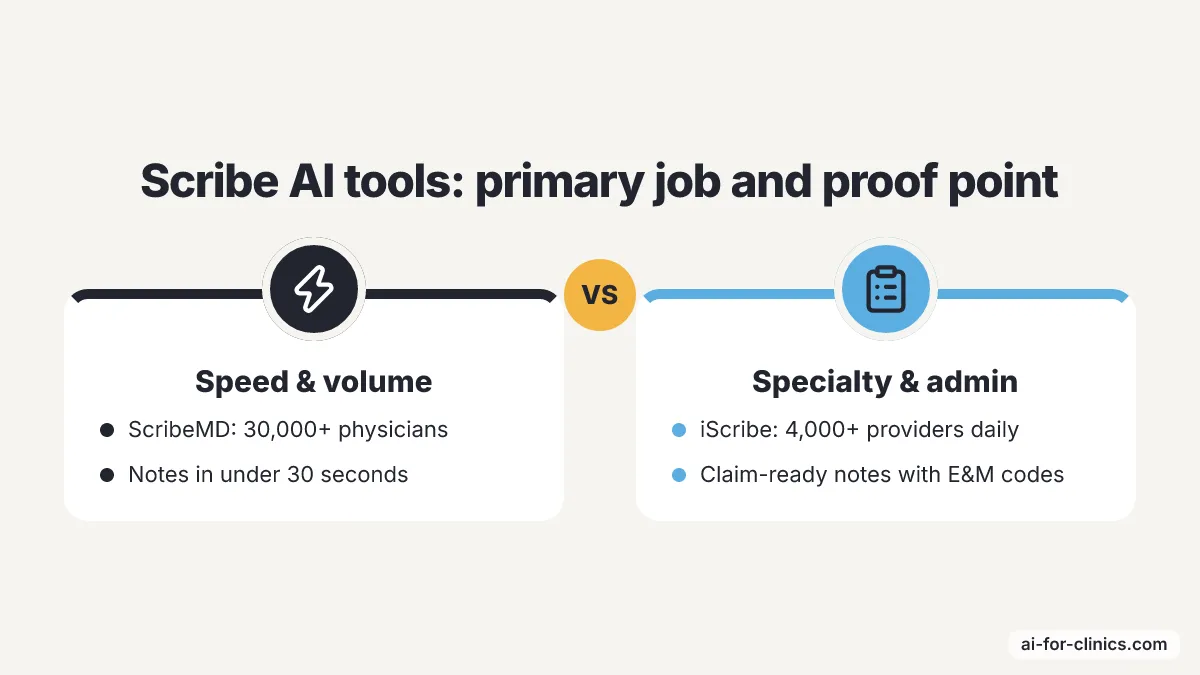
A clinic shortlist gets clearer when each tool is compared on the job it claims to do, not on generic AI language. Documentation tools overlap, but their stated proof points point to different buying questions.
| Tool | Primary clinic job | Strongest supplied proof point | Best-fit evaluation question |
|---|---|---|---|
| VELMENI AI | Dental imaging, claims, and voice workflows | Unified 2D/3D imaging, claims, and voice platform | Can one dental platform reduce handoffs across imaging, claims, and charting? |
| ScribeMD | Clinical note generation | Trusted by 30,000+ physicians and notes in under 30 seconds | Does speed reduce after-visit note work without lowering note quality? |
| Vero | Clinical AI documentation | Used at Cleveland Clinic and Stanford Medicine and other named institutions | Does institutional use translate to the clinic's specialty and note standards? |
| CureMD AI Medical Scribe | Ambient transcription and documentation | Uses ambient listening technology for instant transcription and documentation | Does the visit conversation become a usable note with limited editing? |
| Medwriter.ai | Automated documentation | Helps clinicians save hours on clinical notes | Does the clinician trust the automated note after review? |
| iScribe Health | Specialty notes and E&M support | Writes claim-ready notes for 4,000+ providers daily | Do claim-ready notes and coding suggestions reduce rework? |
| Heidi Health | Consult transcription and admin workflow | September 2026 launch added clinical AI admin agents | Does broader workflow automation justify a larger rollout effort? |
The table also shows where a cheaper or narrower tool can be the right choice. A clinic that only needs fast notes should not buy a broader workflow platform before proving that clinicians will use the documentation output every day.
What recent AI signals should shape a clinic shortlist?
The FDA's September 2026 update matters because diagnostic and monitoring AI are not the same purchase as scribe software. The FDA said it had authorized over 1,600 AI-enabled medical devices for marketing in the United States as of September 2026, which gives clinics a separate reference point when a tool makes diagnosis, imaging or monitoring claims.
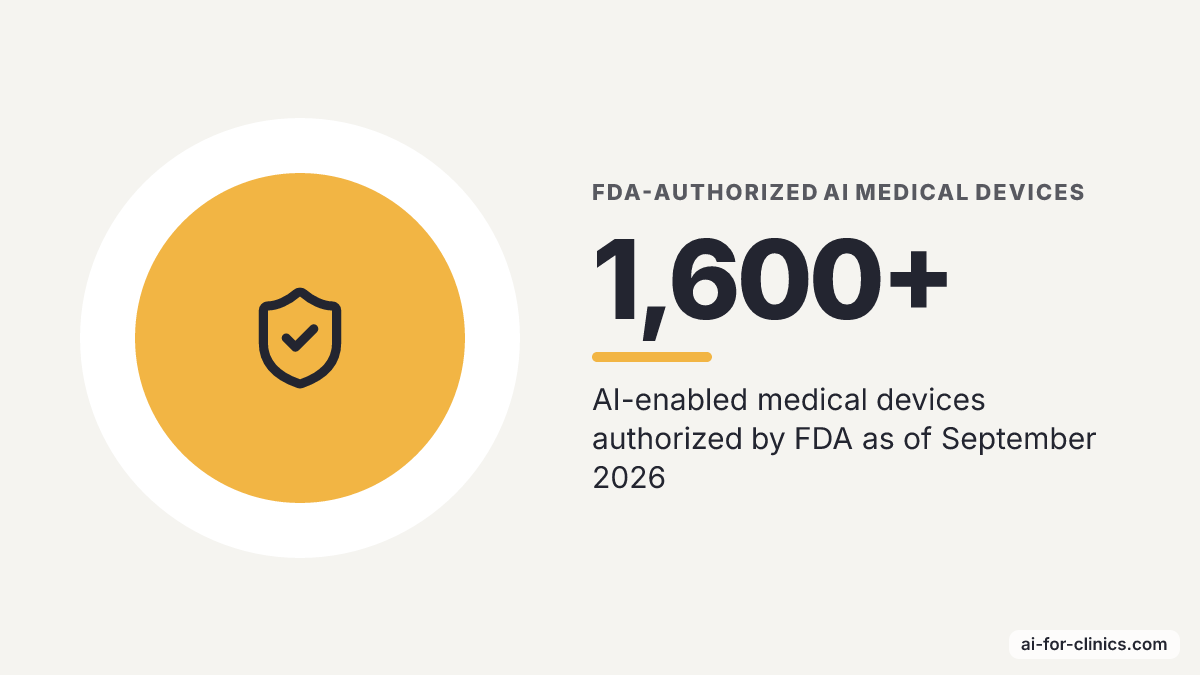
A clinic choosing diagnostic or monitoring AI should not treat a scribe shortlist as enough. FDA authorization, intended use, clinical evidence and device oversight belong in that process, while general documentation tools should be tested on note quality, clinician review time and workflow fit.
The Department of Veterans Affairs signal is also worth watching for ambient documentation buyers. Nextgov/FCW reported in September 2026 that the VA would allow medical facilities to use an ambient scribe under a new enterprise contract with a ceiling of $775.72 million over five years across eligible vendors, which shows that ambient note-taking is moving into large-scale health system procurement.
The FDA's August 2026 device news points in a different direction: automation is expanding beyond notes. The FDA announced authorization of a robotic blood draw device, which matters to operators because some clinic AI and automation decisions will involve physical procedures, not just software inside the chart.
How should a clinic test the shortlist?
A clinic should run a short workflow test before negotiating a larger AI contract. The test should use real note types, real clinician review, and a clear pass-or-fail threshold for whether the tool removes work from the day.
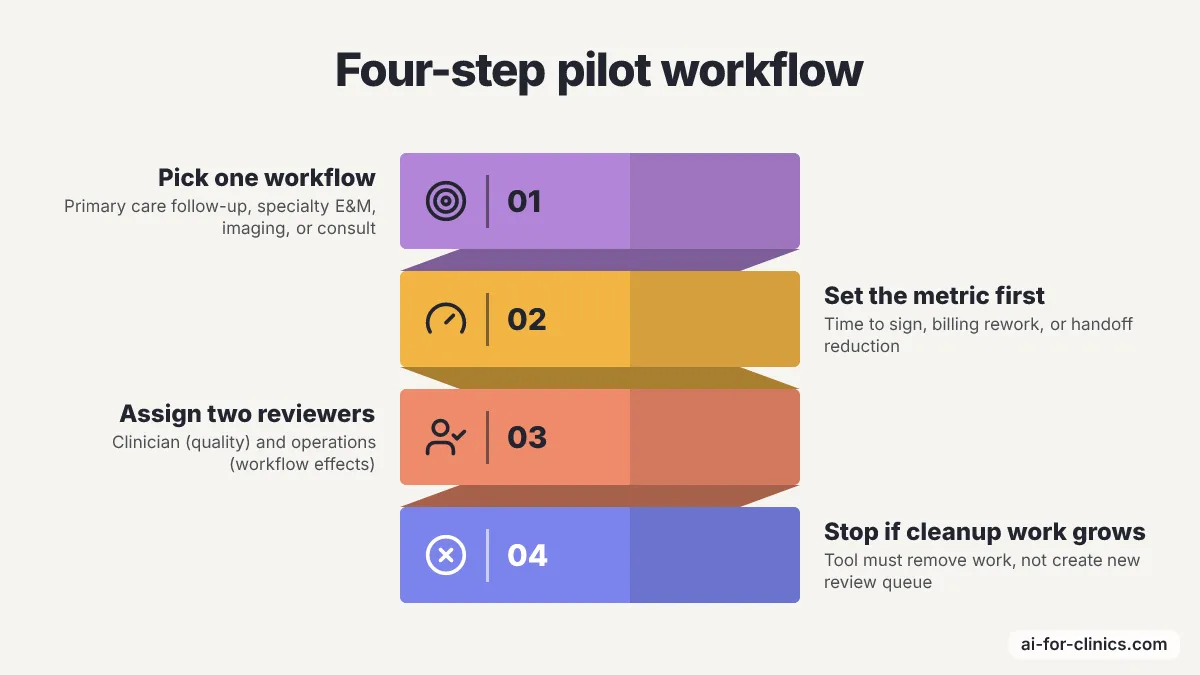
Start with one workflow, such as primary care follow-up notes, specialty E&M documentation, dental imaging review, or consult transcription. A mixed pilot across too many visit types makes the result hard to interpret because each specialty has a different definition of a good note.
Choose the metric before the vendor demo. For ScribeMD, the metric may be time from encounter to signed note; for iScribe Health, it may be billing rework after AI-assisted E&M suggestions; for VELMENI, it may be whether imaging, claims and voice workflows reduce handoffs inside a dental visit.
Assign one clinician and one operations owner to review pilot output. The clinician should decide whether the documentation is clinically acceptable, while the operations owner should track downstream effects such as unsigned notes, claim edits or follow-up tasks.
Stop the pilot if the AI output creates a second review queue that nobody owns. A tool that produces impressive drafts but adds unassigned cleanup work will frustrate clinicians and hide the true cost of adoption.
Conclusion
Start with the workflow that is already slowing the clinic down, then choose the AI tool whose stated job matches that bottleneck. A clinic with unsigned notes should test a scribe. A specialty practice with documentation-linked billing work should look closely at claim-ready notes and coding support. A dental clinic with imaging, claims and voice needs should evaluate a dental platform rather than a general note tool.
The first step is a contained pilot with one visit type, one accountable clinician, and one operational metric. The advice stops at the shortlist: vendor selection still depends on contract terms, integration details, security review and the clinic's own tolerance for changing daily work.