Summary: Massachusetts medical clinics can enhance their operations by choosing AI tools tailored to their specific needs. Athenahealth is ideal for streamlining clinic operations, AIwithCare excels in identifying patients for clinical trials, Dyad Medical specializes in medical image interpretation, and Boston Technology Corporation offers custom AI solutions for clinics with unique requirements. Selecting the right tool depends on the clinic's workflow challenges and operational goals.
A healthcare provider reviewing clinic overhead faces a crowded software market where every vendor promises automated triage or predictive charting. WBUR reported in May 2026 that UMass Memorial is making a $100 million AI investment and building a proprietary data platform to train clinical machine learning models. That scale of spending highlights the pressure on independent practices and regional health centers trying to separate practical day-to-day software from massive academic experiments.
Evaluating the top AI tools for medical clinics in Massachusetts requires filtering out vague platform pitches and targeting the precise administrative or diagnostic bottleneck in the facility. A medical practice struggling with claim denials, schedule gaps, clinical study enrollment, or radiology backlogs will fail if it buys software designed for a different operational layer.
Physical location within Massachusetts provides access to local clinical networks and engineering teams, but geography alone cannot justify a procurement contract. Clinic directors, practice administrators, and healthcare investors need to assess each platform by its core software category, its daily user, and the technical lift required to deploy it.
1. Athenahealth: best for clinic operating infrastructure
Athenahealth suits clinics that need one cloud-based system, athenaOne, for electronic health records, practice administration, medical billing and patient messaging.
Practice leadership seeking to consolidate disparate software systems often starts with foundational infrastructure. The Athenahealth athenaOne profile outlines how the Boston-headquartered company delivers a cloud-based clinical operating system called athenaOne, combining electronic health records, practice administration, medical billing, and patient messaging in a single environment. Medical centers benefit most when administrative intelligence runs directly inside daily charting and revenue workflows instead of requiring external plug-ins.
Administrative fragmentation remains the primary operational reason to consider this system. When a medical group loses staff hours to disconnected billing handoffs, unread patient messages, and disjointed chart notes, implementing a standalone clinical algorithm yields minimal return until the underlying administrative framework stabilizes.
The operational trade-off centers on system breadth versus clinical specialization. Athenahealth proves unwieldy if a medical clinic simply needs an isolated computer-vision tool for diagnostic imaging or an automated engine for clinical research enrollment, as the platform focuses on practice management rather than niche clinical algorithms.
2. AIwithCare: best for trial patient identification
AIwithCare suits research-active practices and clinical trial sites that need to find eligible trial participants within their own patient populations.
Clinical research teams lose months of progress when qualifying participants slip past routine screening protocols. The AIwithCare Studio overview shows that the Boston-based Mass General Brigham spinout built its flagship software, AIwithCare Studio powered by RECTIFIER, to locate and recruit eligible candidates for clinical trials directly from patient populations. Clinical trial sites and research-active medical practices find the highest return here when recruitment delays stall study milestones.
Participant screening operates on criteria distinct from ordinary clinic administration. Practices focused primarily on answering inbound telephone calls, resolving disputed insurance claims, or reading diagnostic scans will find little utility in trial enrollment software, which serves clinical study coordinators rather than front-desk billing staff.
Regional research investments continue to expand clinical data initiatives across the Commonwealth. Health Care News reported in November 2026 that UMass Amherst and Mass General Brigham secured a $24,499,836 renewal grant from the National Institute on Aging for MassAITC to advance artificial intelligence tools for aging and dementia populations across Massachusetts. That research funding expands local clinical trial infrastructure and creates clear demand for automated participant screening tools.
3. Dyad Medical: best for medical image interpretation workflows
Dyad Medical suits specialty outpatient clinics and diagnostic imaging centers that want cloud-based machine learning support for reading medical images.
Specialty practices dealing with diagnostic imaging backlogs require targeted software rather than administrative suites. The Dyad Medical applications site details how the Boston-based developer creates cloud-based machine learning tools designed to assist physicians in analyzing medical images remotely. Specialty outpatient clinics and diagnostic imaging centers gain an immediate advantage when reading backlogs delay definitive patient care plans.
Evaluating diagnostic image analysis requires clinics to verify specific technical boundaries before signing a contract. Medical directors must verify which imaging modalities the software processes, how readings fit into specialist interpretation queues, and who retains legal accountability for final sign-offs before treating cloud-assisted reading as a cure-all.
The operational benefit of this software is technical focus. Dyad Medical does not attempt to manage appointments, submit insurance claims, or overhaul the primary medical record, which simplifies evaluation for clinics that already know their precise imaging constraints.
4. Boston Technology Corporation: best for custom healthcare AI builds
Boston Technology Corporation suits health systems and multi-site clinical networks that need custom-built healthcare AI rather than off-the-shelf software.
Organizations with proprietary workflows or complex data architectures often outgrow pre-packaged vendor software. Information on Boston Technology Corporation healthcare AI shows the Marlborough-headquartered engineering group employs more than 100 cloud engineers trained in HIPAA, GDPR, and SOC2 compliance, supported by over twenty years of healthcare software development. Health systems and specialty clinical networks turn to this firm when commercial software cannot accommodate their specific data protocols.
Commissioning custom software requires significant operational commitment from internal clinic leadership. Building a bespoke system forces clinical directors and data administrators to map exact data pipelines, supervise testing cycles, and manage regulatory controls, which demands far more staff hours than subscribing to a commercial cloud product.
The primary reward of custom development is long-term workflow ownership. A regional health network or multi-site medical practice can construct tools around existing clinical routines, whereas a solo practice or small community clinic should stick with off-the-shelf software to avoid high development expenses.
How should a Massachusetts clinic choose among them?
Workflow classification must precede vendor selection. Athenahealth targets practice management infrastructure, AIwithCare automates clinical study recruitment, Dyad Medical assists diagnostic image review, and BTC builds proprietary architectures for organizations with dedicated engineering budgets.
| Tool | Software category | Primary daily user | Best fit |
|---|---|---|---|
| Athenahealth (athenaOne) | Practice management, EHR, billing, patient messaging | Practice administrators, billing staff, clinicians | Clinics with fragmented administrative systems |
| AIwithCare (AIwithCare Studio) | Clinical trial participant identification | Clinical study coordinators | Research-active practices and trial sites |
| Dyad Medical | Cloud-based medical image analysis | Physicians reading medical images | Specialty outpatient clinics and imaging centers |
| Boston Technology Corporation (BTC) | Custom healthcare AI development | Internal technical specialists and data administrators | Health systems and multi-site networks with engineering budgets |
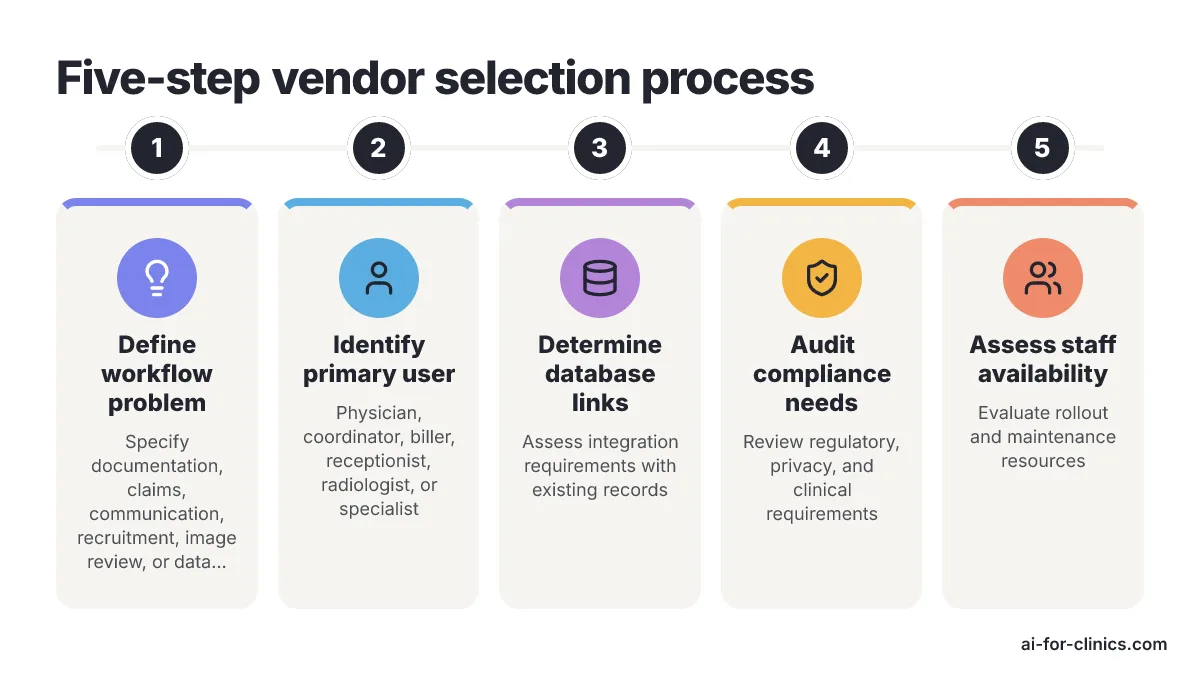
Practice administrators can structure their selection through five practical milestones:
- Write the precise workflow problem in plain language before booking demonstrations, specifying whether the breakdown happens in documentation, claims processing, patient communication, trial candidate matching, image review, or bespoke data aggregation.
- Identify the primary daily user across the clinical or administrative roster, whether that is a physician, study coordinator, medical biller, front-desk receptionist, radiologist, or internal technical specialist.
- Determine which existing database or electronic record the software must link with, recognizing that an enterprise record system requires completely different technical resources than an external imaging application.
- Audit the regulatory, privacy, and clinical compliance requirements associated with the software category before procurement proceeds.
- Assess internal staff availability for software rollout and maintenance, keeping in mind that bespoke engineering builds demand sustained leadership oversight compared to commercial cloud subscriptions.
State legislative policy now dictates stricter procurement standards. The Massachusetts House of Representatives announced in June 2026 that it passed the Consumer Data Privacy Act, legislation establishing enforceable consumer privacy rights and company accountability once reconciled with the Senate. Medical facilities deploying machine learning tools must audit vendor data collection, retention policies, and storage practices, even when deploying non-diagnostic office software.
Clinical algorithms are also advancing into specialized outpatient screenings. Yahoo Finance reported in October 2026 that Everlywell launched nationwide distribution of Clairity's FDA-authorized risk software, which calculates a patient's five-year breast cancer risk directly from standard screening mammograms. Specialty breast-health centers seeking that specific capability should buy certified risk-assessment technology rather than attempting to adapt a general clinic automation system.
AI for Clinics operates as Clinsight's directory of U.S. healthcare software startups. Medical operators, venture investors, and clinic founders use the directory to compare technical specializations across the market before entering vendor sales discussions.
Adjacent startup research helps when clinical leaders face choices across broader care delivery models. Teams considering digital workflows can review profiles such as 123 Virtual Clinic startup or 2020 Vision Care startup to decide whether procurement should focus on regional vendors, specialty niches, or virtual outpatient setups.
Capital strategy remains distinct from individual software procurement. DDS Founders Fund Management acts as a specialized venture firm combining almost three decades of direct dental industry connections and operational knowledge with investment research, serving oral healthcare founders rather than general medical clinic purchasing teams.
Operational needs dictate the final vendor category. Select Athenahealth to repair practice management infrastructure, AIwithCare to fill clinical trial cohorts, Dyad Medical to assist diagnostic image interpretation, and BTC when proprietary clinical processes demand a custom-built engineering solution.
Conclusion
Before you book demos with vendors, write the clinic's internal operational breakdown in a single sentence. Practice managers should pair a clinical lead with a department administrator, so they can identify the exact snag, such as slow patient messages, trial screening backlogs, delayed imaging reads, or missing database connections. Putting that on paper takes about two or three business days of watching the front desk, nurses, and doctors do their work.
Procurement guidance only goes so far, since it helps you find software that fits those daily routines. Sorting the choices into clear categories will narrow the field, but leadership still has to run security audits on the software, work out business associate agreements, check diagnostic liability coverage, and run test batches using actual patient charts before spending any money on the top AI tools for medical clinics in Massachusetts.
Frequently Asked Questions
What are the best AI tools for medical clinics in Massachusetts?
The best AI tools for Massachusetts medical clinics include Athenahealth for streamlining clinic operations, AIwithCare for identifying patients for clinical trials, Dyad Medical for medical image interpretation, and Boston Technology Corporation for custom AI solutions. Each tool is tailored to specific operational needs, such as practice management, trial recruitment, image analysis, or custom software development.
How does Athenahealth benefit Massachusetts medical clinics?
Athenahealth benefits Massachusetts medical clinics by providing a cloud-based clinical operating system called athenaOne. It consolidates electronic health records, practice administration, medical billing, and patient messaging into a single environment, reducing administrative fragmentation and improving workflow efficiency. This system is ideal for clinics needing comprehensive practice management rather than niche clinical algorithms.
What is AIwithCare used for in medical clinics?
AIwithCare is used in medical clinics to locate and recruit eligible candidates for clinical trials directly from patient populations. It is particularly beneficial for clinical research teams facing recruitment delays that stall study milestones. The software is designed for clinical study coordinators rather than general clinic administration, making it ideal for practices involved in active research.
Why would a clinic choose Dyad Medical for image interpretation?
A clinic would choose Dyad Medical for image interpretation because it offers cloud-based machine learning tools specifically designed to assist physicians in analyzing medical images remotely. This is particularly advantageous for specialty outpatient clinics and diagnostic imaging centers experiencing backlogs in diagnostic imaging, as it helps streamline the image review process without managing other administrative tasks.
When should a clinic consider Boston Technology Corporation for AI solutions?
A clinic should consider Boston Technology Corporation for AI solutions when it has proprietary workflows or complex data architectures that outgrow pre-packaged vendor software. BTC provides custom healthcare AI builds, requiring significant operational commitment from clinic leadership to map data pipelines and manage regulatory controls. This option is best for health systems with dedicated engineering budgets seeking long-term workflow ownership.