Summary: The best artificial intelligence systems for clinics in Florida include Clincy for dental treatment coordination, MedReception AI for custom front-desk automation, EliseAI for high-volume patient engagement, Ambience Healthcare for pediatric clinical documentation, Nuance DAX Copilot for EHR-native ambient documentation, and Abridge for large-scale enterprise integration. Each system offers unique benefits tailored to specific clinical needs and operational efficiencies.
For the 1,000+ clinics and healthcare startups in our directory, picking an artificial intelligence system starts with one bottleneck. Maybe it's missed patient calls, maybe it's documentation fatigue, or maybe it's weak follow-up after visits. Solve the worst one first, because that is where the fastest return usually shows up.
Generic AI tools create privacy problems fast, so choose vendors that connect directly to your practice management system, or PMS, or your electronic health record, or EHR, and give you a signed Business Associate Agreement, or BAA. AI for Clinics is Clinsight's directory of U.S. Healthcare startups with over 1,000 companies indexed, plus founder info, funding stage, and what each one builds, with filters by state and healthcare vertical.
AI systems for clinics at a glance
| System | Best for | Main job |
|---|---|---|
| Clincy | Dental practices | Treatment coordination and recall via text, tied to the PMS |
| MedReception AI | Independent medical offices | AI receptionist for calls, scheduling and triage |
| EliseAI | High-volume specialty practices | Scheduling and patient questions across voice, text and web |
| Ambience Healthcare | Pediatric practices | Ambient scribe for EHR documentation |
| Nuance DAX Copilot | Epic and other EHR users | Ambient documentation inside the EHR |
| Abridge | Large health systems | Enterprise ambient notes linked to source audio |
1. Clincy: Best for dental treatment coordination
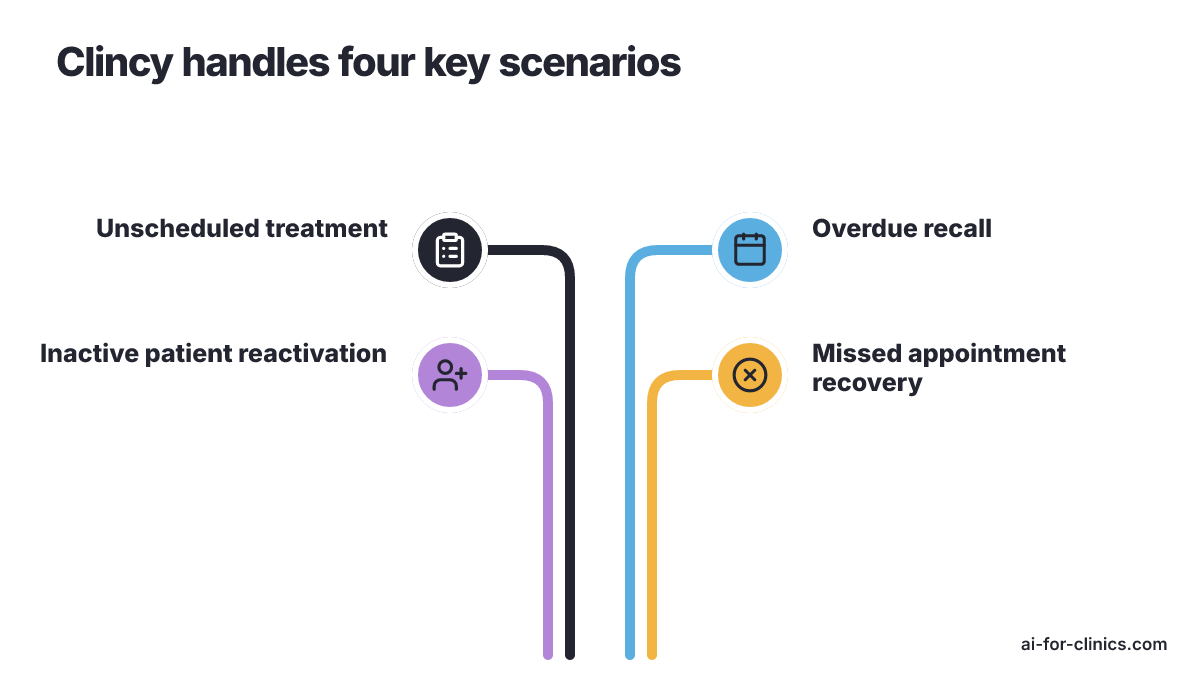
Clincy is an AI treatment coordinator for dental practices that automates follow-up work and turns recommended care into booked appointments. It personalizes text conversations using the practice's treatment info, insurance details, and payment options, and it ties patient outreach directly to the PMS. The system handles unscheduled treatment, overdue recall, inactive patient reactivation, and missed appointment recovery. Questions that need a clinical decision or a personal touch still stay with humans.
It connects with systems like Open Dental, Dentrix, and CareStack, and practices can set rules for patient selection and scheduling. Clinics that use this kind of coordination report better patient retention, and that matters because retention is often a major factor in the long-term health of a dental practice (Clincy | Clinic Software, 2026).
2. MedReception AI: Best for custom front-desk automation
MedReception AI, based in Bradenton, Florida, offers a physician-built AI receptionist that answers calls, schedules appointments, and triages patient requests. A practicing physician built it, so the platform is set up for the messier parts of independent medical offices, including routing calls to the right staff, handling after-hours coverage, and fitting into existing workflows. Each installation gets custom settings for scheduling rules and escalation steps. That lets clinics cut routine call volume while urgent or complex matters still reach staff. In practice, it replaces old answering services with a HIPAA-compliant digital option. Clinics using MedReception AI have reported fewer missed calls, which improves patient satisfaction and day-to-day efficiency (Talkie.ai, 2026).
3. EliseAI: Best for high-volume patient engagement
EliseAI provides a conversational AI platform that handles scheduling and patient questions across voice, text, and web. For busy practices such as dermatology or ophthalmology groups, EliseAI plugs into the EHR and reads provider templates and open slots in real time, so it can book or reschedule visits without staff help.
In a deployment at Texas Dermatology, the system handled 2,000 calls per month and brought in over 250 new patients each month, while saving staff more than 130 hours of work. It supports over 50 languages and runs 24/7, so patients can deal with scheduling needs, intake requirements, or billing questions at any hour. This 24/7 access helps practices with a diverse patient base, since it fits different schedules and language preferences.
4. Ambience Healthcare: Best for pediatric clinical documentation
Ambience Healthcare runs an AI operating setup built around an ambient scribe and documentation helper, developed alongside Pediatric Associates, which happens to be the biggest private pediatric primary care practice across the United States. Known as Ambience AutoScribe, the program translates full appointments straight into the EHR, even when rooms get noisy with kids, parents, and medical staff talking at once. Offloading all that chart work saves doctors over an hour every day, freeing them up to look at their patients instead of a monitor (Ambience Healthcare, 2026).
The software shines during messy conversations involving several family members or shifts between languages. It tracks which person said what, sorting all of it into clean notes ready for billing. Pediatric care demands this sort of thorough tracking, and having clean documentation without extra typing prevents errors from creeping into child health files.
5. Nuance DAX Copilot: Best for EHR-native ambient documentation
Nuance DAX Copilot runs ambient chart tracking directly inside major EHR platforms such as Epic, listening in the background while clinicians speak with their patients. Doctors using it report getting their evenings back, pointing to lower burnout rates and visits that feel much less rushed. Because the tool lives right inside the primary records software, staff members never have to fiddle with third-party browser add-ons or paste text between open windows. Everything stays locked down under the hospital's existing security rules. Big regional networks get clean charts without adding friction to daily clinical shifts.
6. Abridge: Best for large-scale enterprise integration
Abridge operates on an enterprise scale. It turns bedside dialogues into structured notes ready for billing audits, already wired into major operations like UCHealth, Kaiser Permanente, and the U.S. Department of Veterans Affairs.
The Contextual Reasoning Engine pulls details from past visits along with standard medical rules, linking each recorded note back to the exact snippet of spoken audio. Health systems pick it when rolling out software to thousands of clinicians across several clinics because it manages nursing notes, coding pipelines, and immediate chart suggestions without breaking down. Connecting all those systems takes care of back-office friction, so doctors spend their shifts working directly with patients.
How to choose and trial an AI system for your clinic
Pick a single task to start, whether that means incoming call handling, room documentation, or the initial check-in line, then test the process on one provider before rolling it out broadly. You will want a signed Business Associate Agreement (BAA) from the company up front so privacy rules are satisfied, alongside proof that the connection to your existing PMS or EHR actually works. Clinics running large teams across Ohio, Florida, or nearby states will want options like Abridge or EliseAI, which hold solid track records across regional lines. Give your trial run about 60 days before checking on staff satisfaction, actual minutes saved, and conversion numbers. Keep your current staffing routines in place until your test group proves the new setup runs accurately.
Frequently Asked Questions
What are the top AI systems for clinics in Florida?
The top AI systems for clinics in Florida include Clincy for dental treatment coordination, MedReception AI for custom front-desk automation, EliseAI for high-volume patient engagement, Ambience Healthcare for pediatric clinical documentation, Nuance DAX Copilot for EHR-native ambient documentation, and Abridge for large-scale enterprise integration.
How does Clincy improve dental treatment coordination?
Clincy automates follow-up work by turning recommended care into booked appointments. It personalizes text conversations using treatment info, insurance details, and payment options, and ties patient outreach directly to the practice management system. This helps with unscheduled treatment, overdue recall, inactive patient reactivation, and missed appointment recovery, leading to better patient retention.
What benefits does MedReception AI offer for front-desk automation?
MedReception AI provides a physician-built AI receptionist that answers calls, schedules appointments, and triages patient requests. It handles routine call volumes while ensuring urgent matters reach staff, improving patient satisfaction and day-to-day efficiency. Custom settings for scheduling rules and escalation steps allow it to fit seamlessly into existing workflows.
How does EliseAI support high-volume patient engagement?
EliseAI handles scheduling and patient questions across voice, text, and web, integrating with the EHR to book or reschedule visits in real time. It supports over 50 languages and operates 24/7, accommodating diverse patient needs. This system has been shown to save staff time and bring in new patients, as demonstrated in a deployment at Texas Dermatology.
What makes Abridge suitable for large-scale enterprise integration?
Abridge turns bedside dialogues into structured notes ready for billing audits, integrating with major operations like UCHealth and Kaiser Permanente. Its Contextual Reasoning Engine links recorded notes to spoken audio, managing nursing notes, coding pipelines, and chart suggestions. This reduces back-office friction, allowing doctors to focus on patient care.
How does Ambience Healthcare help pediatric clinics?
Ambience Healthcare's AutoScribe turns full appointments into EHR notes, even in noisy rooms with children, parents, and staff talking at once. It tracks which person said what and sorts the conversation into clean notes ready for billing.
How does Nuance DAX Copilot fit into an existing EHR?
Nuance DAX Copilot runs ambient documentation directly inside major EHR platforms such as Epic, so staff do not need third-party browser add-ons or copy text between windows. Notes stay under the organization's existing security rules.
What should a clinic check before choosing an AI system?
A clinic should confirm that the vendor signs a Business Associate Agreement (BAA) and that the system connects directly to its practice management system (PMS) or electronic health record (EHR). Start with one task and one provider, then expand once the trial shows the setup runs accurately.
Related reading
- Top Artificial Intelligence Tools for Healthcare Clinics
- 6 Caregiver Operating Systems for Different Care Settings
Sources
- AI Medical Receptionist for Clinics & Private Practices | MedReception AI
- Pediatric Associates And Ambience Healthcare Partner To Redefine Pediatric Care With Generative Ai
- Clincy | Clinic Software