Summary: For primary care clinics, the best AI platform depends on specific needs and constraints. Freed is ideal for independent practices seeking quick, affordable scribing solutions. Abridge suits Epic-based health systems with enterprise capabilities. Ambience offers comprehensive coding capture for multi-specialty groups. Microsoft Dragon Copilot integrates well with existing Microsoft ecosystems. Heidi Health provides a trial option for testing ambient documentation, while Talkie.ai addresses front-desk automation.
The usual advice for a primary care clinic looking at AI is easy enough: buy the ambient scribe with the biggest name and the deepest Epic integration. For a two-provider family medicine practice on athenahealth, that advice falls apart. It pushes you into a six-figure sales process for a product whose main feature, native Epic embedding, your EHR cannot use, while a self-serve tool at $79 a month would have been charting your notes by Friday.
The decision is not which platform is best. It is which platform fits your EHR, your provider count, and the job you actually want done: documentation, coding capture, or front-desk volume. A study found that primary care clinicians saved time with AI scribes, but only when they used the tool often enough, which many did not. That gap in use, not the vendor's marketing, is where most AI purchases go wrong. This ranking orders six platforms by how well each matches a primary care clinic's real constraints, starting with the option that fits the most of them.
1. Freed: self-serve scribing for independent primary care
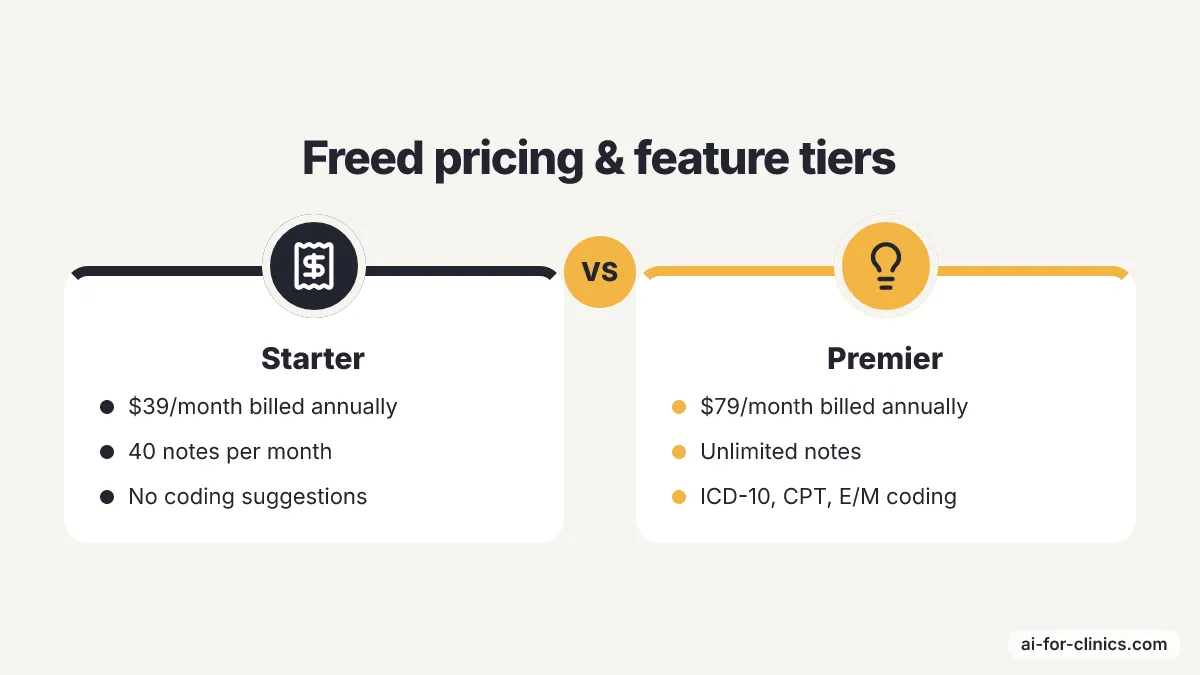
Freed is the best fit for the clinic this article is written for, an independent primary care practice that wants working notes in minutes, not a procurement project. It is priced and scoped for the five-provider clinic, not the health system, with unlimited notes at $79 per month billed annually and a 40-note Starter tier at $39 per month billed annually, verified against its pricing page in November 2026. What makes it stand out for primary care specifically:
- Specialty templates for family medicine, internal medicine, pediatrics, and psychiatry, plus a "Learn My Format" feature that trains the note on your own structure
- ICD-10, CPT, and E/M code suggestions on the Premier tier, so documentation and coding happen in one tool
- One-click EHR push into browser-based EHRs on Premier, with audio deleted automatically after note generation and a signed BAA
- A 7-day free trial with no card required, and Core free for residents and trainees
The trade-off is real. Freed sends notes into browser-based EHRs rather than through native bidirectional EHR APIs, so a clinic that needs two-way integration or population-health administration should pass. For everyone else, the cost per note is among the lowest in this ranking, and the 2026 JAMA finding that primary care clinicians saved nearly 25 minutes of EHR time per day with scribe adoption applies to any tool your clinicians will actually use in most visits. If you are comparing options state by state, our top AI solutions for Illinois clinics walks through the same fit test with regional context.
2. Abridge: the Epic-native choice for health-system primary care
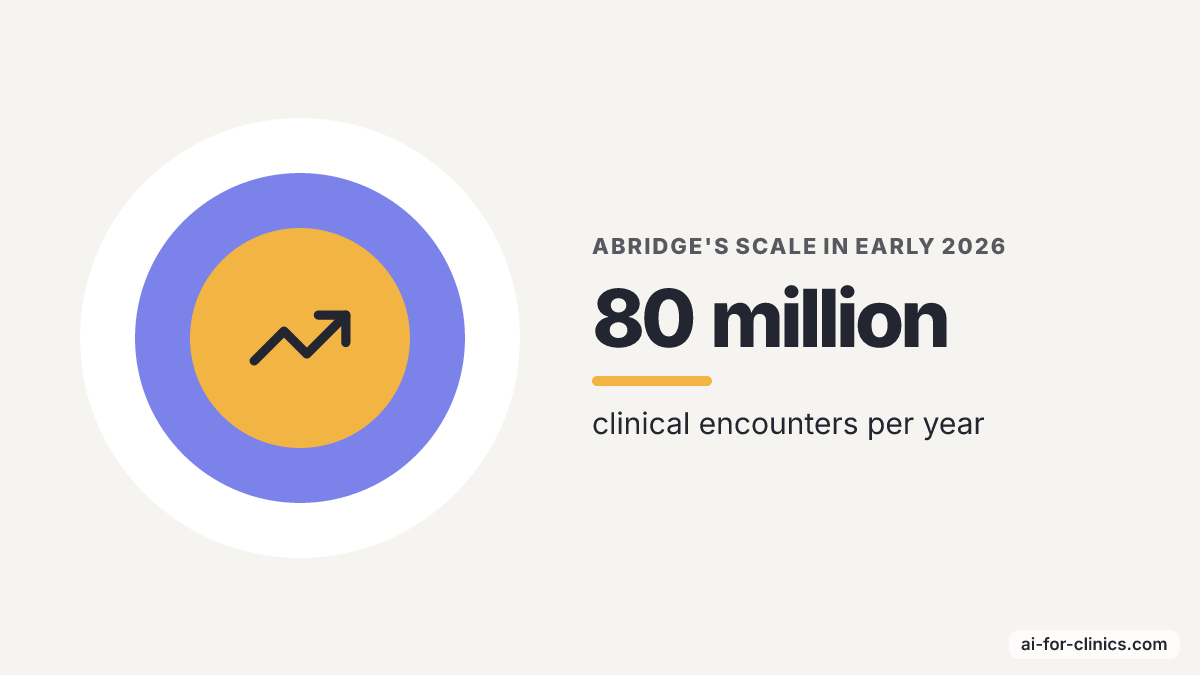
Abridge is the biggest ambient scribe in this group, and it has the funding to match. It has raised more than $800 million, reached a $5.3 billion valuation after its $300 million Series E round led by Andreessen Horowitz in mid-2025, and by early 2026 it was already running in more than 200 health systems. Those sites included Mayo Clinic, Johns Hopkins, and Kaiser Permanente. It was also on pace to handle roughly 80 million clinical encounters a year.
Its edge is simple. Abridge was Epic's first "Pal", so the AI note drops straight into Epic workflows instead of sitting off to the side. West Virginia University Medicine's rollout gives the cleanest primary care signal: a pilot that began with a small group in May 2025 grew to more than 1,200 clinicians, and the system says users save an average of 11 minutes a day on charting. At Allegheny Health Network, a meaningful share of primary care clinicians use it.
This is for primary care teams inside Epic-based health systems, or for large groups that can live with enterprise sales and annual contracts. A report said Abridge has a sizable share of automated medical scribing, just behind a leading competitor. A small independent clinic that does not use Epic should skip it. There is no self-serve signup, and the parts that justify the price are the ones your EHR cannot take advantage of.
3. Ambience Healthcare: coding capture, not just notes
Ambience makes sense when the business case depends on coding revenue as much as on clinician time. AutoScribe writes a structured note in about 90 seconds, but AutoCDI is the part that changes the equation. It checks the note against ICD-10 and CPT rules while the visit is still fresh, then flags missing details before billing sees the chart.
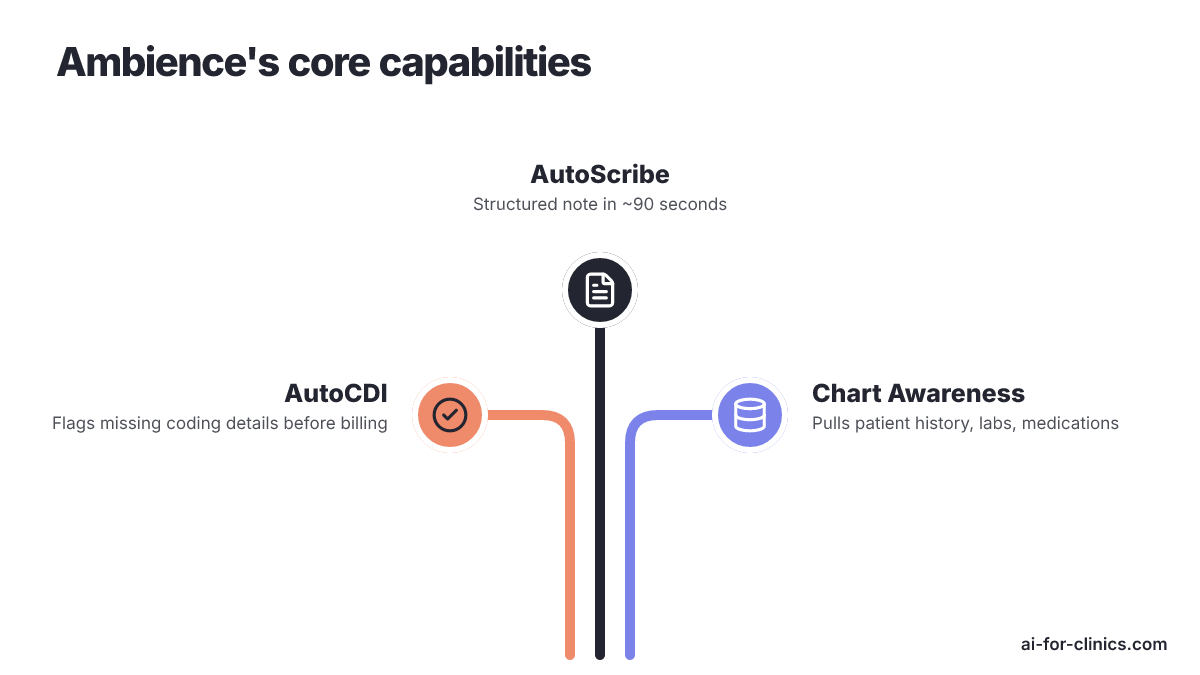
A Chart Awareness feature pulls in the patient's longitudinal record, earlier notes, labs, and medications. That matters because the assessment and plan can reflect the visit history, not just the few minutes in the room.
The evidence behind Ambience is unusually concrete for this category. A Cleveland Clinic pilot tested the platform across many specialties before signing, and the published result showed time savings per visit with broad adoption within a few weeks. It also has a 97.7/100 KLAS score and AAPC-verified coding accuracy.
Pricing is quote-only, but industry estimates suggest the core module and full suite of modules have a significant cost per provider per year. That is the named exception in this ranking. A small primary care clinic that only wants notes will pay for parts it never touches. Ambience fits a multi-specialty group or a primary care department that needs help with coding integrity, with native APIs into Epic, Oracle Cerner, and athenahealth, plus no self-serve trial.
4. Microsoft Dragon Copilot: the incumbent EHR path
Microsoft Dragon Copilot, the successor to Nuance DAX, is the ambient scribe to look at when your practice already lives inside Microsoft tools and wants dictation plus documentation in one place. A report puts it near the front of the market, and enterprise pricing is often described with a notable monthly cost per clinician. The old research on its predecessor is worth reading before anyone signs a contract. A 2024 cohort study of 99 providers across 12 specialties found that DAX reduced documentation time from 5.3 minutes per patient to 4.54 minutes, a statistically significant drop, and it improved 24-hour documentation completion. The same study also found no measurable effect on patient safety, no significant lift in patient experience, and no productivity gain for fee-for-service providers. After-hours EHR time actually got worse for participants.
This is for practices that want a Microsoft-backed, quote-based enterprise tool and will judge it on documentation time alone. The plain reading of that cohort is narrow but real: fewer minutes per note, not more visits and not better outcomes. If the goal is revenue capture or front-desk relief, this is not the tool that does that work.
5. Heidi Health: test before you pay
Heidi Health is the pick for a clinic that wants proof of ambient documentation before spending budget. It has a free tier and paid plans, and outside reports put the paid tier at about $150 per user each month. The target user is any clinician who wants templates and ambient notes without signing an enterprise contract.
The reason to start here is adoption data. One study found that how often scribes were used mattered more than the vendor's quality. Frequent users saved meaningful time and added more visits. A free tier gives clinicians room to build the habit before they buy seats, which helps with underuse.
The trade-off is simple enough: Heidi's paid tier costs more per seat than Freed's Core plan, and its integrations reach less far than Abridge's or Ambience's. This is a trial-and-adoption play. It is not the end point for a group that already knows ambient scribing works.
6. Talkie.ai: the front-desk gap scribes leave open
Every scribe on this list stops at the exam room door. Scribes do not handle scheduling, billing, or prior authorization, and for a primary care clinic whose bottleneck sits on the phone line and in the intake queue, that gap is the one that matters. Talkie.ai is an AI front-desk platform built for that job. Pricing starts at $1,000 per month for about 5,000 minutes of AI work, BAAs are in place for US healthcare clients, and it connects with athenahealth, ModMed, Elation Health, and AdvancedMD.
It fits primary care clinics that have already handled documentation, or that are willing to buy documentation and front desk as separate tools, and that lose calls at lunch, after hours, or when the phones pile up.
Before buying, count the calls your front desk misses or answers slowly in a week, multiply that by the value of one booked visit, and compare the total with the $1,000 monthly floor. If the missed-call volume does not clear that line, a cheaper add-on such as Freed's Front Desk product, starting at $149 per month, covers the same ground for less money.
For operators who want a broader view of these categories beyond scribing, this guide to choosing AI platforms by clinic need breaks the choice down by records, quoting, marketing, and hiring, and our top AI tools for healthcare clinics covers the wider field. If you are comparing vendors as a category, the AI for Clinics directory indexes more than 1,000 US healthcare startups with founder info, funding stage, and each company's product, filterable by state and vertical.
How to pick: the fit test that decides
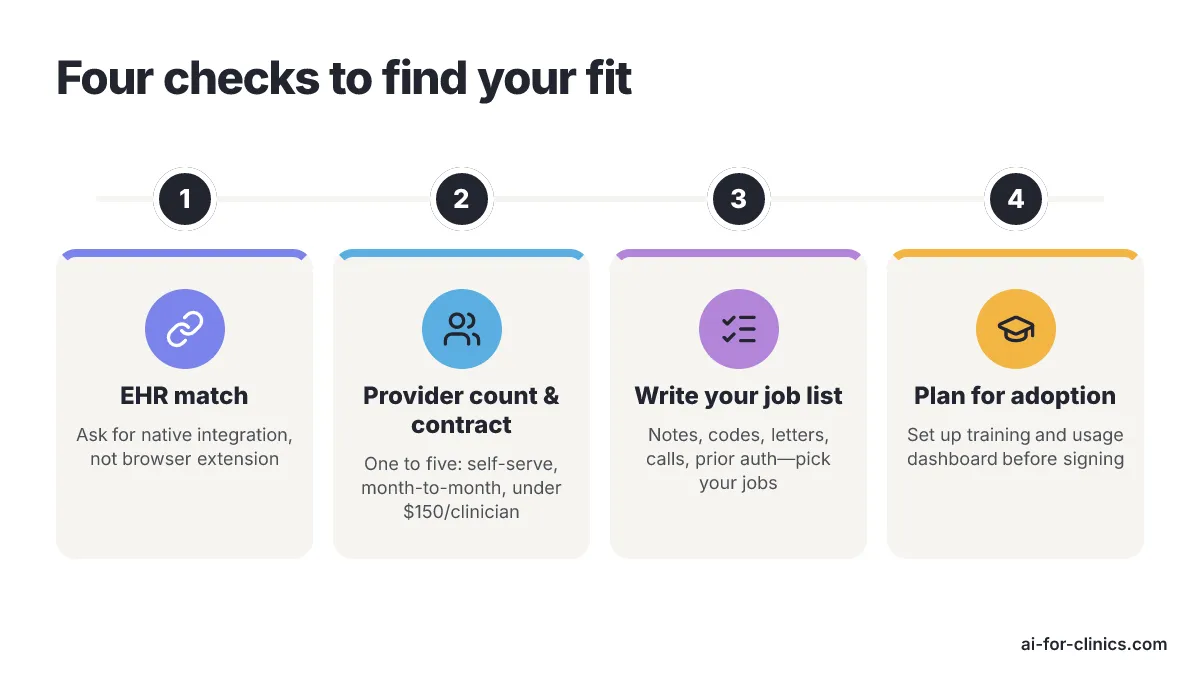
Run every candidate through the same four checks, in this order:
- EHR match. Name your EHR and ask for a native integration, not a browser extension or copy and paste. Abridge and Ambience have native APIs into Epic, Cerner, and athenahealth. Freed pushes into browser-based EHRs. Anything that needs copy and paste adds a step for your clinicians on every note.
- Provider count and contract shape. For one to five providers, self-serve, month-to-month, under $150 per clinician per month. For ten or more, ask for a group tier with SSO, admin dashboards, and an organization-wide BAA, and expect quote-based pricing.
- The job list. Write down every job you want done: notes, codes, patient letters, missed calls, prior auth. A scribe covers the first three. Anything beyond that calls for a second product, and one platform that claims all of it usually means paying for modules you will not use.
- The adoption plan. The data says the tool helps only with frequent use, and many adopters never get there. Set aside time for training and a usage dashboard before you sign, because the purchase is the easy part.
A 2025 competitive analysis of six AI scribes in primary care found that all produced good to excellent quality notes, but none were consistently error-free, with common errors including omissions and SOAP structure mistakes. Whatever you choose, the clinician still reviews every note. That review step is the cost of the category, and no vendor on this list removes it.
Conclusion: which AI platform fits your primary care clinic
Start with the EHR match and the provider count, then pick the most affordable tool that meets both needs: for most independent primary care clinics, this is a self-serve scribe, not an enterprise contract. Sign up for the free trial, put it in front of one clinician for two weeks, and measure visit-level usage before buying seats for the rest of the practice. This advice stops at the exam room: if your bottleneck is coding revenue or the phone line, that is a separate purchase with its own math, and the scribe decision should not be the one that carries it.
Frequently Asked Questions
What AI platform is best for independent primary care practices?
Freed is ideal for independent primary care practices that want quick and affordable scribing solutions. It offers specialty templates and coding suggestions, and it is priced for smaller clinics with a self-serve model.
Which AI platform integrates best with Epic-based health systems?
Abridge is the best choice for Epic-based health systems. It integrates directly into Epic workflows, making it suitable for large health systems and groups that can handle enterprise sales and contracts.
What AI platform should a multi-specialty group use for coding capture?
Ambience Healthcare is suitable for multi-specialty groups that need comprehensive coding capture. It offers features like AutoCDI for coding integrity and integrates with major EHR systems like Epic, Oracle Cerner, and athenahealth.
Is there an AI platform that offers a trial option for ambient documentation?
Heidi Health provides a trial option for ambient documentation. It offers a free tier that allows clinicians to test the platform before committing to a paid plan, which helps build usage habits and assess the tool's effectiveness.
What AI platform can help with front-desk automation in primary care clinics?
Talkie.ai is designed for front-desk automation in primary care clinics. It handles tasks like scheduling and billing, filling the gap left by scribe platforms that focus only on documentation.
Recommended resource
Related reading
- Top 6 Artificial Intelligence Solutions for Illinois Clinics
- Top AI Platforms for Medical Clinics in New York: 5 Picks
- Top Artificial Intelligence Tools for Healthcare Clinics
- Choose AI Platforms by Clinic Need: Records, Quoting, Marketing, Hiring