Summary: Illinois clinics seeking artificial intelligence solutions have several options tailored to specific needs. Tempus AI offers provider-facing assistance, Evolve Health AI focuses on implementation work, and ReasonWorks.ai provides systems-level AI. Clinical Data Intelligence specializes in documentation, Inference Analytics offers enterprise platforms, and MedicalSuite.ai provides growth consulting. Each solution aligns with distinct operational goals, from workflow optimization to strategic growth planning.
Practice managers sitting through late-afternoon software demonstrations hear an endless pitch about frontier language models and benchmark scores. General technical capability matters far less to medical practices than day-to-day fit, because an algorithm cannot rescue a clinic if it lands on the wrong desk, breaks existing intake routines, or clutters medical records. Finding the top artificial intelligence solutions for clinics in Illinois means matching vendor architecture to the bottlenecks in front of the staff: charting backlogs, split office systems, slow integration, or plans to grow the clinic.
Illinois healthcare has been shifting toward more specialized clinic workflows. In November 2026, Inviah moved its AI-enabled home-visit platform from beta testing into full commercial deployment across Illinois, linking mobile physicians with homebound patients while automating clinical charting. One month earlier, in October 2026, Northwestern Medicine teamed up with OpenEvidence to activate an EHR clinical evidence integration that places peer-reviewed medical guidance inside provider chart views.
Choosing software across the state starts with naming which team member owns the problem before anyone starts comparing vendor features. The six providers analyzed below cover different jobs: frontline clinical assistants, hands-on rollout teams, cross-department coordination systems, structured note platforms, hospital-scale architectures, and advisory services for expansion strategy.
1. Tempus AI: best for provider-facing AI assistance
Tempus AI suits physician-led practices that want a conversational clinical assistant used directly by credentialed staff during consultations.
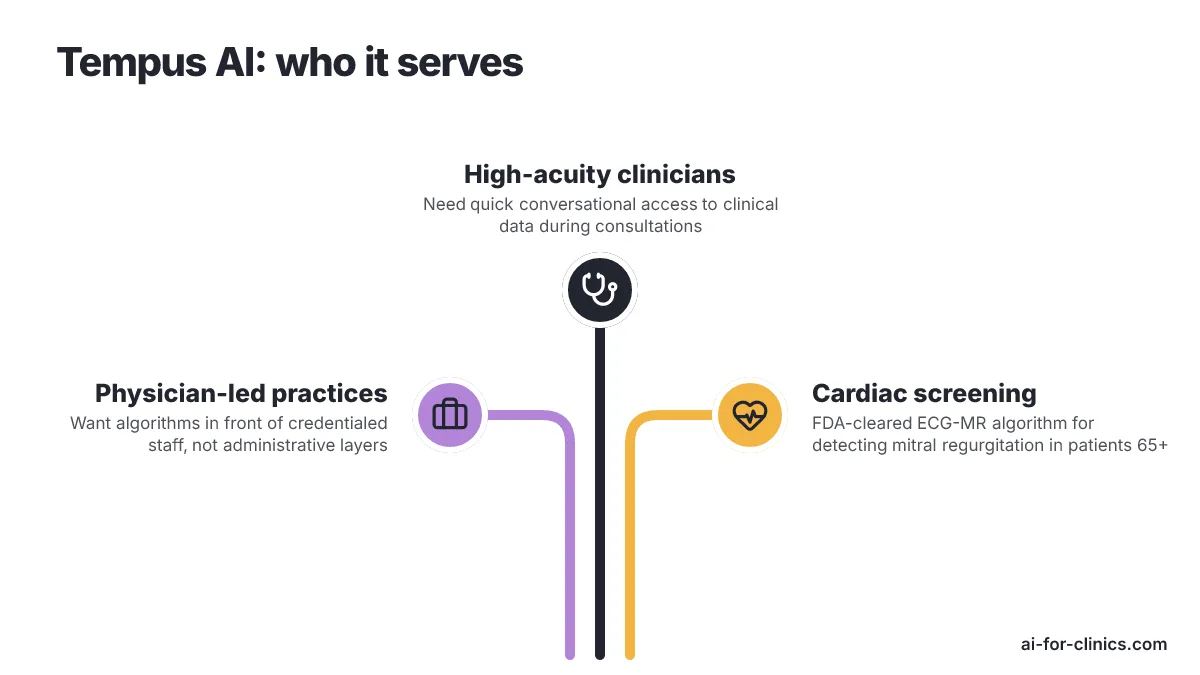
Clinicians with high-acuity patient panels need quick conversational access to clinical data during active consultations. The provider-facing digital assistant from Tempus AI places generative machine learning inside physician-led decision paths, serving practices that want algorithms in front of credentialed staff rather than routed through administrative middle layers. Medical groups looking at this layer skip broad management consulting and put interactive query tools straight into clinical hands.
Regulatory milestones back up the company's technical footing in the state's clinical sector. In September 2026, Chicago-headquartered Tempus received clearance from the U.S. Food and Drug Administration for its ECG-MR heart-valve AI, a specialized algorithm built to detect indicators of moderate-to-severe mitral regurgitation in patients aged 65 and older during routine electrocardiograms. FDA clearance for a cardiac screening algorithm does not make an administrative assistant tool a medical device, but the clearance still shows deep institutional ability in clinical validation.
Physician networks that want conversational software for diagnostic reasoning get the most from this direct-to-clinician structure. Medical practices weighed down by broken intake paperwork, undocumented charting protocols, or untrained administrative staff should look toward operational rollout specialists instead, because dropping an advanced clinical assistant into an unstructured office leaves the basic administrative friction untouched.
2. Evolve Health AI: best for implementation work in medical offices
Evolve Health AI suits clinics that need hands-on deployment, workflow redesign and staff coaching rather than another software license.
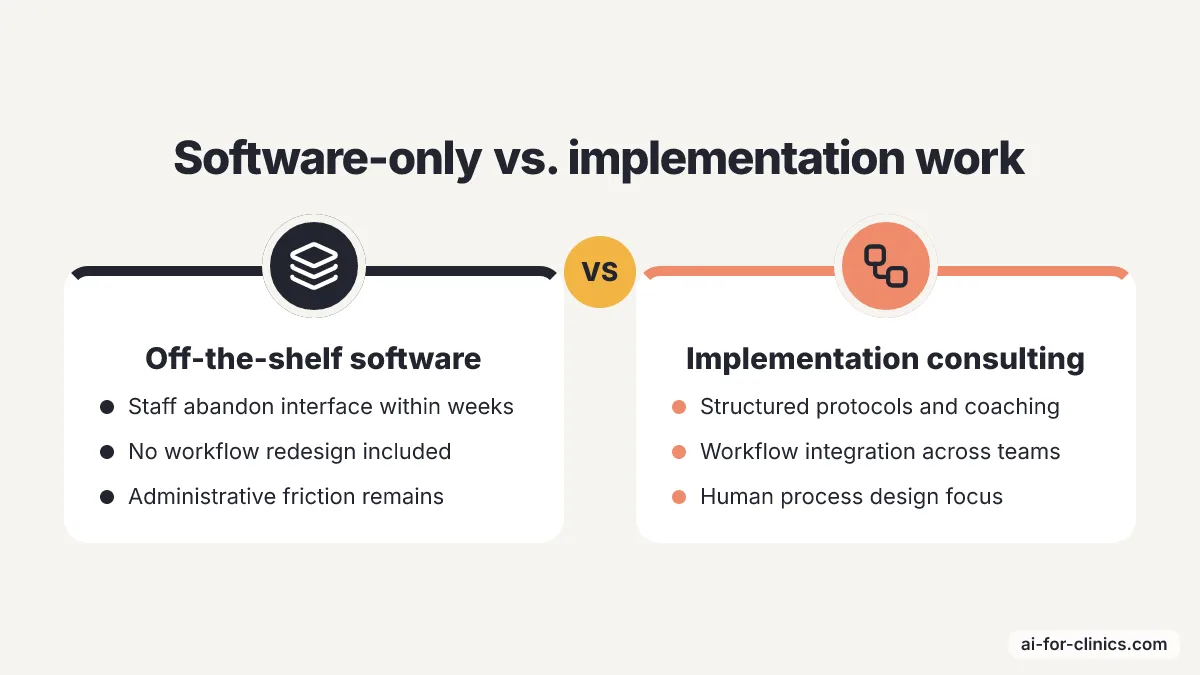
Medical practices often buy specialized clinical software, then watch staff abandon the interface within weeks of installation.
Headquartered in Chicago, Evolve Health AI provides hands-on deployment and workflow integration services for ambulatory medical centers, with a focus on operational redesign rather than selling off-the-shelf software licenses. Operating leadership turns to this advisory approach when practice personnel need structured protocols and direct coaching to adopt algorithmic workflows across reception desks and nursing stations.
Workflow redesign separates implementation engagements from standalone application purchases. Independent facilities dealing with erratic front-desk triage, irregular documentation habits, or absent technical management need disciplined operating sequences mapped out before new code goes live. The firm sets itself apart by centering human process design and staff change management instead of pitching a single software interface.
Healthcare facilities that want structured artificial intelligence operations across multi-disciplinary teams tend to get the clearest returns from this hands-on model. Solo practitioners and micro-clinics working with tight budgets should pause before hiring an implementation consultant, because the discovery hours and workflow audits needed for that work make a small self-installed charting tool a cheaper first experiment.
3. ReasonWorks.ai: best for clinic AI systems
ReasonWorks.ai suits clinics whose bottlenecks sit between scheduling, charting and referrals, where single-desk tools stop helping.
Bottlenecks in a modern medical practice rarely stop at one desk. Chicago-based ReasonWorks.ai builds software setups for healthcare providers and ambulatory clinics, and it targets the spots where patient scheduling, charting queues, and outbound referrals meet.
Groups call them in after one-off software tools stop clearing the administrative jams that spread across back-office desks and clinical rooms.
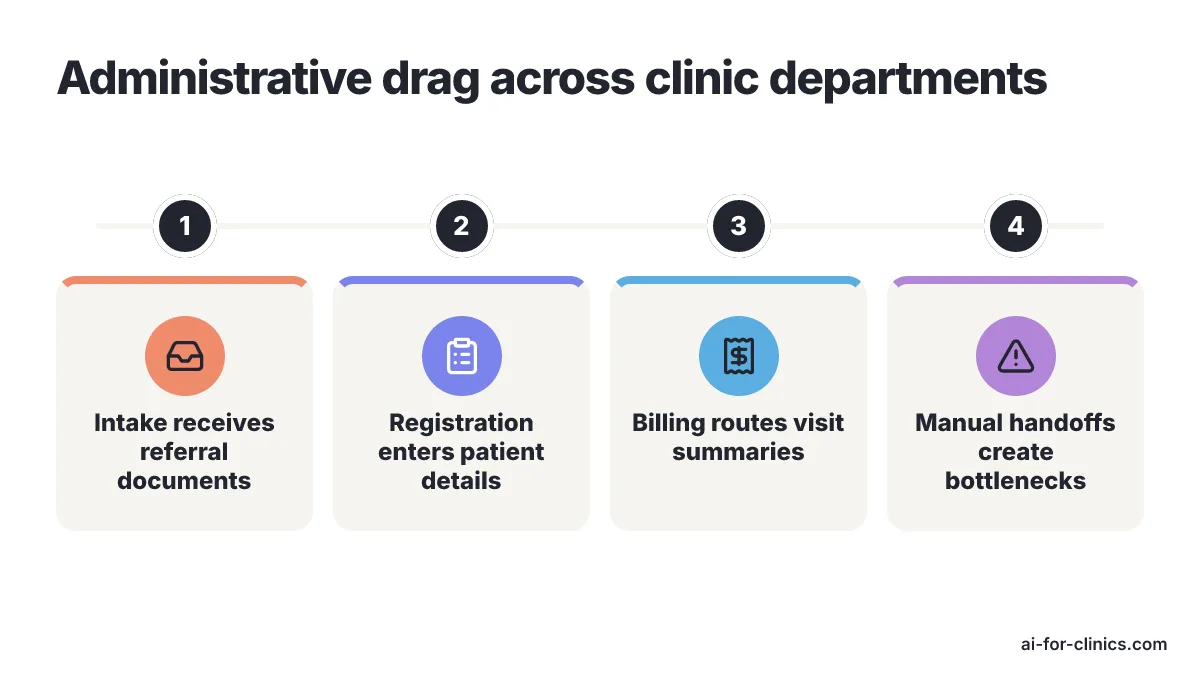
Most administrative drag in a mid-sized clinic builds up along departmental boundaries. Intake staff receive referral documents, pass patient details to registration, then route visit summaries to billing. A basic digital scribe leaves nearly every one of those manual handoffs alone. The company aims at that break by linking the wider system around multi-step clinic procedures, rather than speeding up typing for one doctor.
Clinical leaders who come into sales calls with concrete process maps tend to get more from this setup. They need to lay out the full clinical chain, identify who touches each step, and point to the stall before they talk with engineers. Without explicit workflow maps, an interconnected platform can turn into maintenance work that never touches the clinic's real administrative backlog.
4. Clinical Data Intelligence: best for clinical documentation
Clinical Data Intelligence suits practices whose main burden is writing, coding and organizing visit notes.
Physicians routinely sit in dark offices finishing visit notes long after everyone else goes home. Chicago-based Clinical Data Intelligence develops an algorithmic documentation tool built to produce, format, and organize medical records. Practices look at this focused software when physician fatigue traces back to typing encounter notes, picking ICD-10 billing codes, and assembling take-home plans.
Charting gives clinics a clean baseline for progress checks. Managers can review the gap between a patient leaving and the chart getting signed, follow the speed of billing submissions, and see what text doctors rewrite inside generated notes. Instead of selling a massive operational overhaul across an entire building, the company offers a targeted tool that keeps routine clinical habits in place.
Groups with massive backlogs and clear review procedures see quick results from this tool. Supervisors still need to define how clinicians review the output, by deciding who approves each draft, where staff catch phrasing errors, and how full legal responsibility stays on the doctor's shoulders.
5. Inference Analytics: best for enterprise healthcare AI
Inference Analytics suits hospital chains and regional networks that need enterprise AI with centralized data governance and security review.
Health systems that juggle five locations and ten specialties run into data governance headaches that a single-office product cannot handle. Operating out of Chicago, Inference Analytics builds enterprise-grade artificial intelligence software for hospital chains and regional networks. Technology officers buy into this platform when algorithmic projects need to connect with centralized data repositories and pass security reviews involving hundreds of medical providers.
Deploying software across an entire hospital requires extensive internal review. Long before clinical staff test a prototype, these rollouts need approval from privacy directors, security teams, network architects, and clinical department heads. By aiming its product at big institutions, the vendor provides the centralized security architecture and data controls needed to run separate departmental workflows under one central roof.
Large hospital systems with dedicated IT departments and review boards get the most out of this setup. A private practice with five doctors should pass on it. Enterprise licensing timelines, strict infrastructure demands, and heavy maintenance burdens will quickly sink a smaller team that just wants help with everyday phone messages or visit notes.
6. MedicalSuite.ai: best for clinic growth consulting
MedicalSuite.ai suits medical groups planning new locations or services that want technology decisions tied to growth strategy.
Adding new clinic locations or widening specialty services calls for strategic alignment before anyone spends on specialized technical tools. Serving medical groups and expanding clinics, MedicalSuite.ai steers growth planning and patient acquisition work alongside technology updates. Practice owners turn to this consulting practice when the pain points are empty provider schedules, patient acquisition costs, and multi-location expansion, not immediate charting problems.
Commercial strategy talks need a different lens from software procurement reviews. A healthcare executive weighing market reach, patient retention metrics, and clinical capacity needs guidance on how technology supports business expansion, not technical benchmark scores on medical summarization. The firm stands apart by placing technology purchases inside revenue goals, and it helps leadership teams assess market opportunities before they sign software contracts.
Executive teams growing multi-site medical practices get the most from this commercial focus. Clinics buried under daily charting delays or hospital data migrations should skip growth consulting until administrative stability returns, because spending capital on expansion roadmaps while back-office documentation remains broken only deepens operational distress.
How should Illinois clinics choose among these AI options?
Clinic leaders make better purchasing calls when they start with the workflow that hurts most, not with product labels. A bedside assistant, an implementation agency, a systems integrator, a documentation platform, an enterprise infrastructure engine, and a growth consultancy all do different administrative work, even when search results lump them together.
Clarity starts with a plain statement of the single job the vendor will handle. If a medical practice needs help answering physicians' clinical questions at the bedside, Tempus AI fits that brief. If the problem is slow chart completion, Clinical Data Intelligence is the closer match. When leadership wants an operational artificial intelligence plan across several clinic roles, comparing Evolve Health AI with ReasonWorks.ai gives a useful split between change management consulting and systems engineering.
Big health networks need to separate enterprise data governance work from clinic-level efficiency projects before they sit through sales demos. In September 2026, nference and Rush University System for Health launched an effort to deploy a Rush-hosted clinical data platform for analyzing de-identified clinical records, with the goal of supporting research that may help patient care over the long run. That kind of regional health system project lives on a very different administrative plane from an independent community clinic trying to speed up note completion or sort reception triage.
Before anyone looks at licensing fees, clinical leaders should answer four operational questions:
- Which clinic workflow does the product or service own on day one?
- Which staff members must change their daily work for the rollout to succeed?
- What system does the AI product need to connect with or sit beside?
- What decision remains with the clinician, administrator or executive sponsor?
Medical directors also need to keep regulated diagnostic claims separate from ordinary software contracts. The September 2026 FDA clearance for Tempus and its ECG-MR algorithm shows a strict clearance path built for a narrow diagnostic screening task. General conversational assistants, practice management consultants, and operational rollouts do not have that medical validation, so buyers should not judge administrative automation tools as if they were regulated clinical devices.
Human capital problems should sit beside algorithm choices, not get buried under vendor promises. In specialized dental practices, DDS Recruit's fractional dental recruiting team handles talent searches from start to finish, weighing workplace culture with technical credentials and offering a guaranteed replacement placement within twelve months. A growing dental organization that lacks the people to manage new patient intake has to deal with those hiring gaps on their own, apart from any automated practice software rollout.
Market research works better when local options are viewed against national medical technology, not in isolation. AI for Clinics serves as Clinsight's directory of U.S. Healthcare startups, tracking more than 1,000 healthcare companies by founding leadership, funding history, and specialized technological output.
Practice leaders comparing geographic markets can use the Texas clinic AI shortlist, and administrators who want broader market basics can read the summary of healthcare clinic AI tools. Budget choices should follow the risk in the target workflow, not vendor sales language. A practice with one charting bottleneck can put in a focused documentation tool quickly, while a multi-location clinic network with heavy data governance and electronic medical record dependencies needs to plan for a full enterprise audit. If practice managers cannot name the exact administrative bottleneck causing friction, they should stop software purchases right there, because vendor sales teams will name the problem for them.
Conclusion
Put the exact operational process on paper before talking with vendor sales representatives. Write down the task that needs automation, identify the clinical and administrative staff who will handle daily interaction, note the software systems that need access, and assign legal accountability for operational sign-off. That review takes about two weeks of structured work between a supervising clinician and an operations manager, and it keeps the practice from signing long contracts for tools that do not solve daily friction.
Guidance ends once practice leadership names the operational bottleneck and classifies the software partner that belongs there. After that point, practice executives still need separate legal review of software licensing agreements, data security liabilities, and medical malpractice protections with their counsel.
Frequently Asked Questions
What are the top artificial intelligence solutions for clinics in Illinois?
The top AI solutions for Illinois clinics include Tempus AI for provider-facing assistance, Evolve Health AI for implementation work, ReasonWorks.ai for systems-level AI, Clinical Data Intelligence for documentation, Inference Analytics for enterprise platforms, and MedicalSuite.ai for growth consulting. Each solution is tailored to specific operational goals, such as workflow optimization and strategic growth planning.
How does Tempus AI assist clinicians in Illinois clinics?
Tempus AI provides a provider-facing digital assistant that integrates generative machine learning into physician-led decision paths. This solution is ideal for clinicians who need quick access to clinical data during consultations, allowing them to make informed decisions without routing through administrative layers.
Why choose Evolve Health AI for implementation in medical offices?
Evolve Health AI specializes in hands-on deployment and workflow integration services. They focus on operational redesign rather than selling off-the-shelf software, making them ideal for practices needing structured protocols and direct coaching to adopt algorithmic workflows across reception desks and nursing stations.
What makes ReasonWorks.ai suitable for clinic AI systems?
ReasonWorks.ai targets administrative bottlenecks in medical practices by building software setups that integrate patient scheduling, charting queues, and outbound referrals. They focus on linking systems around multi-step clinic procedures, helping to clear administrative jams that spread across back-office desks and clinical rooms.
How does Clinical Data Intelligence improve clinical documentation?
Clinical Data Intelligence offers an algorithmic documentation tool designed to produce, format, and organize medical records. This tool helps reduce physician fatigue by automating the creation of encounter notes, billing codes, and take-home plans, allowing clinics to maintain routine clinical habits while improving documentation efficiency.
When does Inference Analytics make sense for a healthcare organization?
Inference Analytics fits large hospital systems and regional networks with dedicated IT departments and review boards, where AI projects must connect to centralized data repositories and pass security reviews. Small private practices that only want help with phone messages or visit notes are better served by lighter tools.
Who should consider MedicalSuite.ai?
MedicalSuite.ai fits executive teams growing multi-site practices who need growth planning and patient acquisition work alongside technology updates. Clinics still struggling with daily charting delays should stabilize documentation before investing in growth consulting.
Related reading
- The 6 Best AI Solutions for Medical Clinics in Texas
- Top Artificial Intelligence Tools for Healthcare Clinics
- Top 6 Dental Online Intake Form Solutions Compared
- Top Artificial Intelligence Platforms for Primary Care Clinics