Summary: Compare these clinic technology candidates by the job you need done: mdhub for a behavioral health EHR, Novoflow for agents operating an existing EHR, Metriport for healthcare data connections, Medplum for application-building infrastructure, and Canvas Medical for an EHR with patient-access integrations. Plena Health is an administrative-workflow candidate whose current scope needs direct confirmation. The right fit depends on the clinic's workflow, technical capacity, and evidence from a relevant demonstration, not a universal ranking.
Vendor announcements offer useful context, but they do not establish which product fits an independent clinic: the Ambience Chorus launch, the VA ambient AI contract, the Abridge assistant rollout, and the Tom Health launch. Clinical leaders, startup founders, and healthcare investors may encounter similar claims in very different product pitches. Sorting them out is hard. A team may want to replace the whole record system, slip automations into current charts, or sell one tool for a single office chore.
Administrators looking at the top health tech startups for medical clinics run into wildly different software setups dressed up in the exact same marketing vocabulary. One vendor builds a full clinical system from the ground up, another sells developer toolkits, and a third works only on one specialty bottleneck.
Sorting products from healthcare tech startups by where they sit in an office gives practices a practical starting point for checking scope, contract terms, and implementation responsibilities before product demos get booked.
Do not buy machine intelligence as a concept. A medical group should evaluate financial returns against a defined charting problem, front-desk bottleneck, or billing delay, including the costs of integration, staff review, and maintenance. Algorithmic features should be judged strictly by how well they finish that single job.
Compare the shortlist by workflow
Compare the shortlisted vendors by product category and the workflow each would need to support, then use the demonstration questions to test fit. This is an editorial comparison of the linked vendors' public descriptions and the procurement questions they raise, not a hands-on benchmark or an endorsement of clinical outcomes. The categories describe evaluation paths; they do not establish that a product is suitable for a particular clinic.
| Candidate | Evaluation category | Question to put in the demo script |
|---|---|---|
| mdhub | Behavioral health record system | Can staff complete intake, care planning, notes, and billing handoffs in the proposed setup? |
| Plena Health | Administrative-workflow candidate; current scope unconfirmed | Which tasks and specialties are supported, and what must change in the existing EHR? |
| Novoflow | Agents operating an existing EHR | Which fields can the agent read or change, and how are exceptions reviewed? |
| Metriport | Healthcare data exchange and transformation | Which outside records are available, and how are matching and reconciliation handled? |
| Medplum | Headless EHR and application infrastructure | Which interfaces and integrations must your engineers build and maintain? |
| Canvas Medical | Electronic record with patient-access integration options | Which scheduling and messaging functions are included, configured, or separately integrated? |
Read the linked product sources in each vendor section for the basis of its category. Public descriptions do not replace a written statement of scope, a contract review, or an implementation assessment. Where a capability is unclear, keep it as an unanswered procurement question rather than filling the gap with a favourable assumption.
1. mdhub: behavioral health EHR candidate
The mdhub EHR for behavioral health is a candidate for clinics evaluating a record system designed around behavioral health, rather than a general-purpose automation add-on. Its product page describes a behavioral health EHR and structured care plans; those descriptions are vendor claims, not findings from a hands-on clinic trial.
Psychiatric clinics and counseling centers should check whether intake forms, consent paperwork, treatment plans, and progress notes match their actual work. Ask the vendor to demonstrate the relevant documentation and permission settings rather than assuming that specialty branding establishes compliance.
Observers and founders studying this market should assess mdhub as a specialty record-platform candidate. For clinic buyers, the practical question is whether the demonstrated screens support their staff's documentation process without additional workarounds. Do not assume that a specialty interface eliminates after-hours charting; make that a question for a documented evaluation.
Administrators should make vendors run a complete appointment during software demos, starting at patient check-in, moving through the therapy note and diagnostic coding, and ending at claims creation. Check whether the presentation omits steps that would leave assistants tracking billing data in separate spreadsheets. Running a realistic synthetic patient chart through the system helps staff identify specialized-care requirements and manual workarounds; a scripted demonstration is not proof of performance in live care.
Have your team inspect how the system follows patient trends over several sessions, where providers place diagnostic evaluations, and how office billers track authorization deadlines. When clinical directors and front-office billing staff sit down together to run this exact test, the evaluation stays tied to daily clinic realities.
2. Plena Health: investigate practice admin workflows
The Plena Health workflow automation platform is included as an administrative-workflow candidate for specialty practices to investigate, not as a verified promise of reduced workload or migration-free deployment. The accessible page did not provide enough readable product detail to confirm specialty coverage or integration requirements during this review.
Independent surgical and medical specialty groups should start with the front-office process they want to change. Ask Plena Health to document supported tasks, dependencies on the existing record system, and the work retained by staff. Compare that evidence with the effort of replacing the record system rather than assuming that either approach will reduce delays faster.
Specialty medical groups need to judge admin tools against the repetitive coordination work that lands on front-desk coordinators and billing teams. For Plena Health, ask for evidence of the routine tasks the proposed setup would handle, which roles would use it, and where people would still need to step in. Manual phone calls, status checks, and data entry pull staff away from other work, and that pressure shows up quickly in busy offices.
Healthcare technology investors looking at operational software from healthcare software startups should distinguish the proposed administrative use case from an EHR purchase or an API platform. For Plena Health, require confirmation of specialty coverage and supported tasks before comparing the offer with other vendors.
Group practices should define what would count as a useful change in back-office backlog before considering deployment across locations. Practice managers can map a repetitive admin process and mark where patient requests wait or staff re-enter information.
Ask Plena Health to demonstrate those handoffs and identify which steps remain staff responsibilities. Record unsupported or unavailable functions as open questions rather than assuming that a broad automation description covers the clinic's actual workflow.
3. Novoflow: AI agents operating an existing EHR
The Novoflow AI agents platform describes computer-using agents that operate a medical practice's EHR to automate operational bottlenecks. That makes Novoflow a candidate for work inside an existing record system, rather than a replacement EHR.
Do not assume that operating the EHR means an agent is native to it, has unrestricted access, or removes the need for another monitoring screen. Physician leaders should ask which jobs are supported, which fields an agent can change, and where a person must approve the output.
Treat access to notes, orders, and other patient-record fields as an implementation question, not a capability established by the label AI agent. Require a demonstration of permissions, review, and exception handling using synthetic records before considering access to live charts.
Software founders and sector analysts should distinguish agents that operate an EHR interface from assistants that only produce suggestions outside it. Speech-based tools are a related but distinct evaluation category, covered in the site's voice AI startup comparison. For Novoflow, ask how access is authorized and which technical boundaries apply in the proposed host system; do not infer an integration architecture from the product category. A practice that evaluates agents must check technical implementation requirements and audit capability before it gives automated software write access to patient charts.
Clinical evaluation sessions should ask the vendor to demonstrate one defined administrative task, and the demo should show which user starts the action, what chart fields the software reads, and where staff review the final output. Confirm those audit steps with the clinic's clinical, security, and technical reviewers before any automated process touches live patient files; a demo alone does not establish safety or compliance.
4. Metriport: connected healthcare data candidate
The Metriport healthcare data connections offering is a candidate for teams investigating healthcare data exchange, transformation, and access to outside clinical information. Metriport describes those layers on its company page; clinic-specific network coverage and presentation still require verification.
Ask which outside sources can be reached, what records are returned, and how those records appear in the clinic's workflow. A connection to a data network is not evidence that every needed document will be available, correctly matched, or ready for clinical use.
Make record availability, patient matching, readability, and reconciliation explicit evaluation criteria. Do not infer fewer repeated tests, fewer missed conditions, or better treatment outcomes from data connectivity alone. Those benefits would need evidence tied to the clinic's implementation and clinical review process.
Technical directors building custom tools should treat Metriport as plumbing, not finished office software. Teams running remote care models or patient tracking programs should compare prebuilt network connections with the coverage, engineering effort, and maintenance required by direct connections. If your clinic does not have programmers on staff, ask how those outside documents will actually appear for the nurses.
Test the product on an ordinary case. Take a new patient who needs recent discharge papers and blood panels from the hospital, then follow the records from arrival to the doctor's screen. See who reads them and how they shape care.
5. Medplum: infrastructure for healthcare applications
The Medplum headless EHR platform provides infrastructure for teams building healthcare applications, rather than a finished clinic interface. Its documentation describes a headless EHR and FHIR, the healthcare data-exchange standard.
A headless setup separates the underlying record services from the interface a development team builds. Ask which components Medplum supplies and which screens, integrations, scheduling workflows, and maintenance responsibilities remain with your engineers. A platform choice alone does not establish that the resulting application meets the clinic's compliance obligations.
Buying headless software means judging developer flexibility, not looking at pre-made intake forms. Medplum fits teams that keep software engineers on the payroll and run a service model that clashes with fixed ambulatory products.
Independent medical offices without technical staff should pause here. Venture-backed groups with full-time developers can use raw infrastructure to build custom experiences, but a neighborhood clinic may instead need charting software that staff can use without building an application. Before choosing developer tools over a standard clinical system, leadership needs to know whether the team actually has the technical hands to build it.
Map out interface designs, software boundaries, and third-party tools before opening a sandbox account. That work shows which modules developers must build themselves, and it makes clear whether your technical roster can handle ongoing maintenance without confusing raw building blocks with ready-to-run clinic software.
6. Canvas Medical: EHR and patient-access integrations
The Canvas Medical EHR platform is a candidate for clinics evaluating an electronic record alongside patient-access integrations. Canvas describes an open-source patient app that enables integration of patient-side scheduling, messaging, payments, and medical records.
That description does not mean every workflow is built in, enabled by default, or available without configuration. Ask the vendor to separate included functions from optional integrations and custom development. Treat reduced data entry and fewer errors as outcomes to test, not benefits established by combining tools.
Patient access and messaging sit at the front door of a clinic.
Where intake forms, reminders, and follow-up messages live in separate vendor tools, check the handoffs rather than assuming that clean charts mean a connected patient-access workflow. For Canvas Medical, ask how patient communication and scheduling connect to the chart, and which parts depend on the patient app, integrations, or custom configuration.
Market observers and technology entrepreneurs should compare unified platforms like Canvas Medical with single-purpose tools that handle one operational problem at a time. Clinical executives have to decide whether combining communication, self-scheduling, and charting is worth moving away from an existing electronic record system. Separate patient access software also brings recurring maintenance, which adds another layer of work.
Evaluation demos should follow a patient from self-scheduling and automated confirmation messages through chart documentation and follow-up messaging. That full path shows clinic leaders whether the scheduling and communication pieces clear front-office bottlenecks. If a practice keeps standalone communication tools, administrators should still ask what charting advantage the platform gives them.
How should a clinic choose between these startups?
Choose by the workflow you need to change and whether you need to replace the EHR, add administrative automation, connect outside data, or build an application. Compare products that address the same task. An EHR replacement and a data connector answer different questions, even when their sales presentations use similar language about automation.
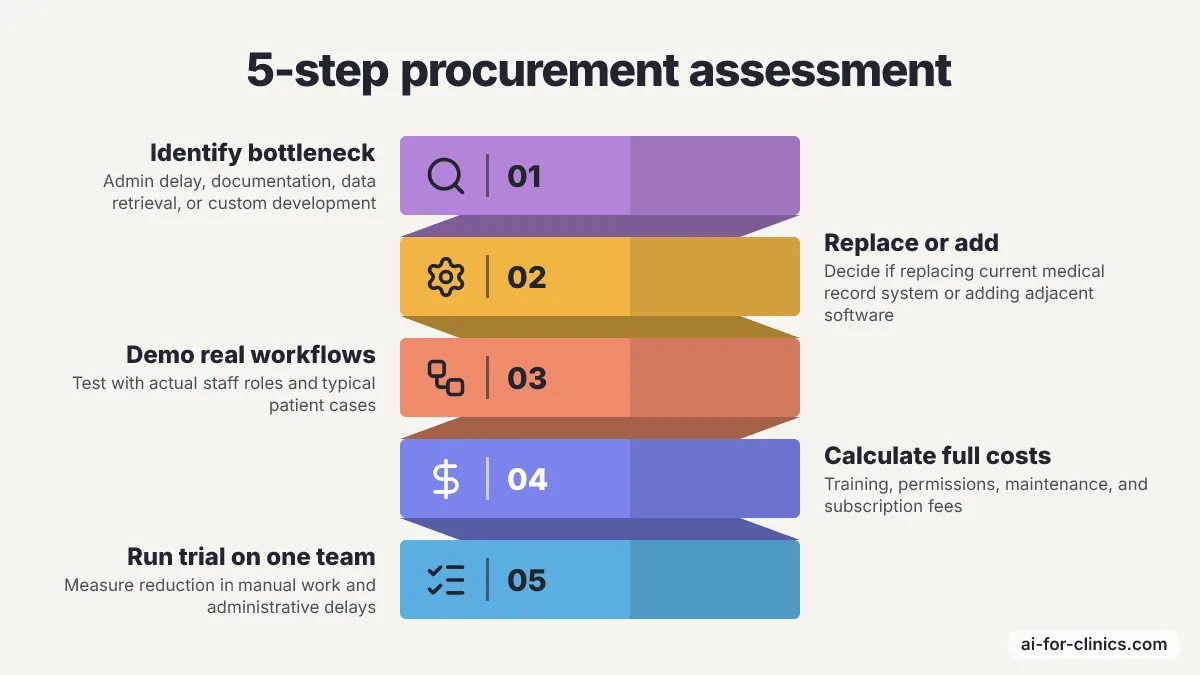
Use the following procurement checklist to turn that category choice into an evaluation plan:
- Identify the specific operational bottleneck causing administrative delay, whether that involves behavioral health documentation, specialty group administrative handoffs, repetitive EHR charting tasks, outside record retrieval, custom clinical app development, or patient communication.
- Decide clearly whether the clinic intends to replace its current medical record system or add software around its existing infrastructure.
- Require software vendors to demonstrate workflows using the practice's real-world staffing structure, including physicians, front-desk staff, billing specialists, and technical staff.
- Calculate full implementation requirements, factoring in internal staff training, technical permission reviews, and ongoing workflow maintenance alongside recurring subscription fees.
- Conduct a tightly scoped trial on one care team, measuring whether the software successfully reduces manual spreadsheet tracking, duplicate data entry, or administrative delays.
Record the findings in a shared comparison matrix so leadership can review the same evidence. Include the evaluated tasks, staff roles, systems retained, and remaining manual handoffs. Keep demonstrated capabilities separate from claims that still need documentation or testing.
Use the linked announcements as market context rather than as a procurement ranking. The Ambience Chorus launch introduces a system-of-context offering. The Abridge assistant rollout introduces a healthcare assistant. The Tom Health company launch describes Lumeris's AI primary-care offering. These announcements are vendor descriptions, not comparative evidence that the products meet an independent clinic's needs.
Use those announcements to frame questions about context, documentation, and care coordination rather than treating the offerings as interchangeable. Ask where each proposed tool gets its information, how the output reaches staff, and what clinical oversight remains necessary. Practice managers should use the answers to clarify whether their facility needs connected patient data, documentation support, or care-coordination workflows, then return to the shortlist category that matches that need.
Practice executives should view large-scale health system software adoptions as broad market indicators rather than direct roadmaps for independent medical practices. Abridge's announcement of the VA ambient AI contract reports its selection to provide ambient AI under the Department of Veterans Affairs enterprise contract through a distribution partner; this is not evidence of fit for a particular independent practice. Independent clinic administrators must still answer fundamental operational questions: where the application runs, what records it reads, and which manual clerical tasks it eliminates.
Dentistry practices evaluating diagnostic imaging, radiographic claims analysis, and dental charting should check dental-specific options rather than assuming general medical platforms cover those workflows. VELMENI dental AI software presents dental imaging software; evaluate its supported image types, intended use, clinical evidence, and integration requirements directly rather than assuming improved diagnostic accuracy or faster operations. Practice leaders seeking specialized dental software should review our dedicated analysis of vertical AI for dentists rather than attempting to force general clinic platforms into a dental operatory.
AI for Clinics is Clinsight's directory of U.S. healthcare startups, with founder info, funding stage and what each company builds, filterable by state and healthcare vertical. Practice executives and operations teams can use the directory to filter healthcare companies by operating state and specialized vertical once they have established the exact product category required.
Founders and corporate development teams studying the market for health tech start ups should classify these vendors by the proposed buyer and workflow rather than general feature comparisons. Assess mdhub and Canvas Medical in relation to clinical record decisions, Novoflow for agents operating existing records, Metriport for data connections, and Medplum for developer infrastructure. Investigate Plena Health separately as an administrative-workflow candidate until its current scope is documented. This grouping is a screening framework, not proof that a vendor meets a clinic's operational constraints.
What evidence should a clinic request before signing?
Request a written scope, a security and data-handling explanation, an implementation plan, and a clear allocation of responsibilities before treating any demo as a purchase decision. Keep the same evidence fields for every candidate so a polished presentation does not substitute for an answer.
- Product scope: List the workflows included in the proposed purchase, any optional modules, and the functions that are only planned. Ask the vendor to distinguish available capabilities from roadmap commitments.
- Record access: Document which systems and fields the tool can read or change, whose account authorizes access, and where a person approves consequential changes. Ask how permissions are removed when a staff member leaves or the trial ends.
- Data handling: Request the proposed contractual terms for patient information, any subprocessors, retention, deletion, and use of data for model training. Have the clinic's authorized legal and security reviewers assess the answers rather than accepting a compliance label as a complete explanation.
- Implementation ownership: Identify the work assigned to the vendor, the clinic, and any integration partner. Include configuration, staff training, exception handling, and maintenance in the evaluation, not just subscription terms.
- Exit and continuity: Ask how records and audit history can be exported, what happens when a connection fails, and which manual process remains available while a problem is resolved.
- Evidence of value: Define the workflow result the clinic wants to observe, record its starting process, and assess the proposed setup against that baseline. Keep vendor testimonials separate from evidence gathered in the clinic's own evaluation.
An unanswered question is a reason to withhold a conclusion, not to assume the most favourable interpretation. Keep a decision log showing which answers came from documentation, which were demonstrated, and which remain unconfirmed. This gives clinical leaders, technical staff, founders, and investors a shared way to discuss product fit without confusing a market category with proof of performance.
Implementation safety before live patient use
Before live patient use, keep demonstrations separate from care and require authorized review of access, output approval, audit trails, and recovery procedures. Use synthetic records while the clinic's authorized clinical, security, and technical reviewers assess access permissions, patient matching, output approval, audit trails, and recovery procedures. Do not treat a vendor's automation or compliance language as approval to let software change live charts. Record who can stop an automated task, how staff will review errors, and what manual workflow remains available if an integration fails.
Build a workflow-specific vendor shortlist
Write down the single operational process that creates the most daily friction across clinical or administrative staff, then restrict vendor evaluations exclusively to software built for that task. A replacement electronic health record, a specialty practice administrative layer, a background EHR agent, an external data connector, and a developer infrastructure platform demand entirely different technical verification from prospective vendors.
Build an authentic demonstration script based on an actual clinic workflow, involving every staff member who touches that process from registration through follow-up. Require each prospective vendor to execute that specific workflow during product demonstrations, recording which software systems remain in place and which clerical tasks disappear. Independent software evaluations end once practice leaders establish a qualified vendor shortlist, because final contract execution, security certifications, and technical integration reviews require direct operational, legal, and clinical verification before software touches active patient care.
Frequently Asked Questions
Which health tech startup is best for a behavioral health clinic?
mdhub is the behavioral health EHR candidate in this comparison, not a verified best choice for every psychiatric clinic or counseling center. Its linked product page describes a behavioral health record system and care plans. Ask clinical directors and billing staff to test intake, consent, notes, coding, and claims handoffs, and verify the clinic's specific documentation and compliance requirements.
Can a specialty clinic use Plena Health without replacing its EHR?
Do not assume that Plena Health can support a specialty clinic without changes to its existing EHR; confirm the proposed deployment directly. The public page available during this review did not substantiate migration requirements or specialty coverage. Map the administrative process you want to change, then ask the vendor to document supported tasks, record-system dependencies, staff responsibilities, and implementation limits.
What should a clinic check before using Novoflow AI agents in its EHR?
Before using Novoflow agents, check authorized access, supported tasks, technical requirements, data rights, audit capability, and human approval points. Its linked site describes agents operating a practice's EHR, but the clinic must confirm the permissions and deployment model for its own system. In a demo, ask what chart fields an agent reads, who starts the task, and where staff review its output before anything is written to patient records.
How can Metriport help a clinic use records from outside hospitals?
Metriport describes healthcare data exchange and transformation; whether a clinic can use a particular outside record depends on coverage, matching, integration, and review. Check the sources reached, records returned, and staff workflow rather than assuming that a network connection delivers every needed document. A practical test is to follow a new patient’s discharge papers and blood panels from their arrival through to the doctor’s screen, and see how the records inform care.
How do Medplum and Canvas Medical differ for medical clinics?
Medplum provides infrastructure for teams building healthcare applications, while Canvas Medical combines an EHR platform with patient scheduling and messaging integrations. The article’s summary presents them as different kinds of options rather than interchangeable products. A clinic comparing them should start with its needs: building an application, using an EHR platform, or adding scheduling and messaging integrations.
Related reading
- Why Startup Founders Demo to Non-Customers: A 2026 Guide
- 5 Voice AI Startups in Healthcare: Alternatives to Kintsugi
- 6 Best Marketing Agencies for Telemedicine Startups in 2026
- The 6 Best Health Tech Startups in New York to Watch
- Top 5 US Startups in Vertical AI for Dentists & Lawyers