Summary: Illinois clinics should shortlist documentation analytics by workflow, then verify the specific product, intended users, and record connection. Clinical Data Intelligence’s ACRADO addresses documentation improvement; Veradigm’s linked offering concerns clinical data registries; PatientIQ emphasizes patient-reported outcomes. Two Point describes conversion quality analysis, ConsentMD describes consent and documentation workflows, and Context⁴ Healthcare describes coding-error identification within payment integrity. These are different evaluation categories, not interchangeable products or a measured performance ranking. Confirm outpatient suitability and the reviewer’s next action before treating a category match as a purchasing recommendation.
The implementation call drags on once the clinic starts asking where the note-quality dashboard lives, who looks at the exceptions, and whether consent forms belong in the same flow. The vendor has slides about artificial intelligence, but the buyer still has to decide whether the real pain point is documentation improvement, outcomes capture, coding error detection, or health record conversion.
The practical move is to stop treating clinic documentation analytics as one bucket. Illinois buyers should choose by the documentation job first, then by the analytics layer attached to that job, whether that is patient records management, consent, coding, outcomes, or conversion quality.
That difference matters because not every documentation tool solves the same problem. The linked OptiMantra report, labeled AI Scribe records visits, could not be retrieved during this review, so it is not used here to establish recording, consent, or note-drafting capabilities. For this comparison, assess the operational signal a platform produces after, around, or across documentation rather than inferring its capabilities from an AI label.
1. Clinical Data Intelligence: documentation improvement
Clinical Data Intelligence's ACRADO documentation improvement platform is an option to investigate when the problem is documentation quality, rather than replacing an electronic medical record management system. Its public site positions the product around clinical documentation improvement and chart review, with an explicit focus on safety-net and community hospitals.
That hospital focus is an important qualification for clinic buyers: ask whether the product supports the clinic's care setting, record format, and review responsibilities before assuming suitability. A clinic operator could bring examples of incomplete or inconsistent notes to an evaluation, while a founder or investor could use documentation improvement as the initial category for diligence. Neither framing establishes that the product has been tested in an Illinois outpatient clinic.
Before a demo, the clinic can gather examples of the note problems that trigger staff follow-up and ask whether the platform can surface those same problems. The team should also name who will review each finding and what action counts as resolution, because analytics without an assigned reviewer leave the original documentation gap untouched.
The trade-off is scope. A platform focused on clinical documentation improvement should be judged on the documentation problems it surfaces and the people who act on those findings, not on whether it also handles consent, outcomes surveys, or conversion projects.
A useful evaluation keeps the success test inside that scope: can the intended reviewer identify a documentation issue, understand why it was flagged, and decide what to do next? A buyer should not assume that a platform positioned for improvement also drafts notes or replaces the clinic's record system, so those requirements need separate confirmation.
2. Veradigm: clinical data and record analytics
Veradigm's clinical data and medical record analytics reference points to its clinical data registries offering, rather than establishing that it is the broadest option for clinics. The linked page is framed for life sciences, which buyers should distinguish from an operational documentation dashboard for an individual practice.
For an organization investigating registry-based analysis, the relevant questions are the available data, intended audience, and permitted use. A buyer who wants a medical record management system should ask which offering provides the system of record and which provides analysis. This article uses the linked registry page to identify an evaluation category, not to establish that Veradigm replaces record storage or that every Veradigm product has the same scope.
A procurement team can make that distinction concrete by bringing a reporting question to the demo, such as what record-level information decision-makers need to review across a program. Then the team can ask which data the analytics uses, what the output looks like, and whether the intended users can act on it without treating the platform as a file repository.
The appeal of a broader analytics platform is that it may fit leaders who need record-level visibility across programs. The trade-off is buying discipline. If the immediate issue is a consent process or a chart conversion, compare the adoption work with the project's specific requirements before assuming a broader platform is appropriate.
For a clinic with a narrow project, the buyer should compare the work needed to adopt a broad analytics layer with the specific deliverable the project calls for. For a team weighing registry or program-level questions, the broader positioning matters more, but the scope still needs to be shown against the team's own records and reporting needs.
3. PatientIQ: patient outcomes analytics
PatientIQ's patient outcomes data platform is an option to evaluate when documentation needs to include patient-reported outcomes. Its public site describes an EHR-integrated patient-reported outcomes program, making outcomes collection a more specific evaluation category than general note review. The linked positioning does not establish comparative superiority or guarantee compatibility with a particular clinic's record system.
Specialty groups, research-minded operators, and health-tech teams can evaluate whether patient-reported outcomes belong in their documentation workflow. If the intended question concerns function, recovery, symptoms, or patient-reported status, ask the vendor which measures the proposed product supports and how staff would interpret the results. This is an evaluation question, not evidence that the article has measured a clinical benefit.
The practical distinction is that PatientIQ belongs in an outcomes analytics conversation, not a generic healthcare document management purchase. Buyers should ask where patient-reported data enters the workflow, who reviews it, and how the findings are tied back to visits or procedures before treating it as a documentation platform.
A clinic can prepare for that discussion by identifying the care milestone at which it wants to collect outcomes information and the staff role that will review the results. Those questions do not assume a particular collection method. They help the buyer check whether the platform's outcomes focus fits the clinic's intended workflow.
The team should also define what it expects to learn from the data before evaluating a dashboard. If the goal is to understand patient-reported outcomes, the buyer needs to see how those data are analyzed. If the goal is simply to store records, the outcomes focus may not match the purchase.
4. Two Point: quality analytics for record conversion
Two Point's quality analytics in health record conversion makes the most sense when you are dealing with migration, conversion, or cleanup work. The vendor is based in Chicago, and it watches data quality while teams move health records from one system to another. That matters most when an organization plans to shift or convert clinical files, rather than create them from scratch.
For a clinic, software platform, or buying group considering a record move, Two Point's published conversion workflow provides a starting point for questions about data quality. Treat format mismatches, missing fields, and incomplete records as test cases to investigate, not as defects that this article has observed in a particular migration. Ask the sending and receiving teams to define how they would recognize each problem before reviewing a vendor demonstration.
Test the proposed conversion workflow on an approved representative sample, using synthetic or appropriately de-identified examples until the clinic authorizes any patient-data access:
- Gather a sample batch of files that reflects the full conversion load.
- Ask the vendor how its quality analytics find errors across that batch.
- Pin down who reads the defect reports and how the team corrects mistakes.
- Decide what hard evidence your clinic needs before it approves the final record transfer.
Timing sets the evaluation scope. The cited Two Point page describes conversion and quality analysis; it does not, by itself, establish the scope of ongoing documentation review, coding audits, or patient outcome reporting. If those functions matter, ask for a demonstration and a written description of the relevant service rather than interpreting a conversion-focused page as proof that they are included or excluded.
For a conversion-focused evaluation, involve the people responsible for both the source records and the destination system. The staff sending the records and the team receiving them need to define what counts as a clean result. Clinical staff who open these charts every day should flag any missing details that could slow patient care later.
5. ConsentMD: electronic consent and documentation
ConsentMD's electronic consent and clinical documentation site describes a mobile application for consent, documentation, communication, and workflow management for home health and healthcare providers. That positioning makes consent workflow the relevant starting point for evaluation; it does not establish that intake forms automatically become structured information in a clinic's existing chart.
Ask the vendor to demonstrate the actual record connection, including how a signed document reaches the clinical file and how staff find it later. Rather than assuming a digital signature resolves a compliance issue, have the clinic's responsible reviewer examine the consent process and the records it produces. The product description alone is not evidence of compliance for an individual practice.
Map the whole workflow before you meet with sales reps. Track the path a consent paper takes from the first patient signature to the moment a provider reviews the completed chart in an exam room. Use that map during the product walkthrough. Have the vendor show each step, and watch what the front desk has to do whenever an intake packet arrives without a required signature.
Scope is the main trade-off to clarify here. The linked ConsentMD page supports a consent and documentation evaluation, but it is not enough to determine the full scope of chart analytics. If outcome reporting, database conversion, or coding review is required, ask whether those functions are available and how they work rather than treating their absence from this comparison as proof that the product cannot provide them.
Keep your consent requirements separate from broader chart analysis goals while you shop for an Illinois clinic. Do not infer clinical-results review or billing-code audit capabilities from signature capture alone. Ask for evidence against each requirement, then decide whether a broader product, an integration, or a separate vendor evaluation is appropriate for the clinic's workflow.
6. Context⁴ Healthcare: coding error analytics
Context⁴ Healthcare describes medical coding error analytics within its payment-integrity offering, making coding discrepancies the relevant evaluation focus. Its public company page describes a payment integrity platform whose analytics engine identifies coding errors and other payment-related issues. That supports a coding and payment-integrity evaluation, not a guarantee of compliance or documentation quality for a specific clinic.
Organizations assessing coding review should ask which findings are supported by the available clinical and billing records. Finding a coding discrepancy is a different task from drafting notes, recording consent, or collecting patient-reported outcomes. Ask the vendor and the clinic's coding lead to show how a finding is checked against supporting documentation rather than assuming an automated flag proves that a claim is correct or incorrect.
Anyone sizing up this tool should bring a coding reviewer into the conversation alongside whoever oversees clinical documentation.
One person can sort out which findings actually help with daily audits. The other can work through who handles chart errors and how feedback gets back to clinical providers. The trade-off is keeping billing and compliance staff directly involved during software evaluation. If clinic managers look at coding analytics only through a clinical workflow lens, they miss the teams responsible for turning error logs into better charts and clean claims.
Ask the vendor to show the handoff in the demo. Ask how the screen presents a flagged discrepancy, which staff member reviews it, and what steps come next. Those checks show whether the system matches the clinic's internal review path without assuming anything beyond its core analytics design.
How should Illinois clinics choose among documentation analytics platforms?
Choose by the documentation task and the person responsible for acting on the result, then verify the product's fit for the clinic's actual setting.
What does the public evidence establish?
This is a workflow-based reading of the linked vendor materials, not a report of hands-on testing or a measured ranking. The ordering does not establish superiority. Inclusion is intended to help buyers serving Illinois clinics investigate relevant categories; it does not certify Illinois-specific availability, legal compliance, outpatient suitability, or a local headquarters. Vendor positioning is evidence of how a company describes its offering, not independent proof of implementation success.
| Platform | Starting point supported by its linked materials | Evidence to request before shortlisting |
|---|---|---|
| Clinical Data Intelligence / ACRADO | Documentation improvement and chart review, with hospital-focused positioning | Demonstration using the clinic's care setting and documentation problems |
| Veradigm | Clinical data registries, with the linked page aimed at life sciences | Confirmation of the specific product, intended users, data access, and clinic reporting use |
| PatientIQ | Patient-reported outcomes collection | Example of the clinic's intended outcomes workflow and record connection |
| Two Point | Data conversion with quality analysis | Reconciliation report showing how missing or altered information is investigated |
| ConsentMD | Consent, documentation, and workflow management | Demonstration of signature handling and the connection to the clinic's chart |
| Context⁴ Healthcare | Coding-error identification within payment integrity | Example finding, reviewer explanation, and route for resolving a discrepancy |
Use this table as an evaluation agenda rather than a feature checklist. A category match is only the beginning: ask which product or service is being proposed, what the demonstration actually includes, and which requirements remain unproven. If the vendor cannot demonstrate a requirement, record it as unresolved instead of treating an adjacent capability as equivalent.
What should clinics verify about patient data and oversight?
Before sharing patient information, ask the clinic's privacy, security, and clinical leads to approve the evaluation process. Request a demonstration using synthetic or appropriately de-identified examples where possible. Ask what information leaves the clinic's systems, who can access it, where outputs are stored, and how corrections or deletions are handled. These are procurement questions, not assertions that a particular vendor provides those safeguards.
For any proposed integration, ask the vendor to show the direction of data movement and the final destination of notes, forms, findings, and audit history. Clarify whether the demonstration uses a live connector, a file transfer, or a mock-up. Request an explanation of permissions, access logging, export options, and the clinic's responsibilities if the service is unavailable. Have qualified advisers assess the relevant contracts and Illinois requirements rather than relying on this comparison as legal advice.
For AI-assisted output, define who checks the result and who may accept or correct it before it influences a clinical record or billing decision. Ask how reviewers can trace a finding back to its supporting record, challenge an apparent error, and document the resolution. Do not assume that a dashboard, a vendor compliance statement, or a polished demo establishes the safety of the clinic's intended deployment.
How can a clinic compare proposals consistently?
Give each vendor the same description of the documentation problem and the same expected reviewer action. Ask for a written account of the included workflow, integration responsibilities, training, ongoing support, and exit process. Keep demonstrated capabilities separate from roadmap items or verbal assurances. Record unresolved questions alongside the proposal so that a compelling presentation does not erase an important limitation.
A useful evaluation record names the source material reviewed, the workflow demonstrated, the staff who assessed it, and the evidence still missing. If hands-on findings are later added to this article, they should identify the evaluation context and limitations rather than imply results for clinics that were not assessed.
Which workflow should the demo test?
The demo should test the documentation problem the clinic has identified, using the intended reviewer and an approved example of the affected record. Clinical Data Intelligence points to documentation improvement, Veradigm to clinical data and record analytics, PatientIQ to outcomes data, Two Point to health record conversion, ConsentMD to consent-linked documentation, and Context⁴ Healthcare to coding error analytics.
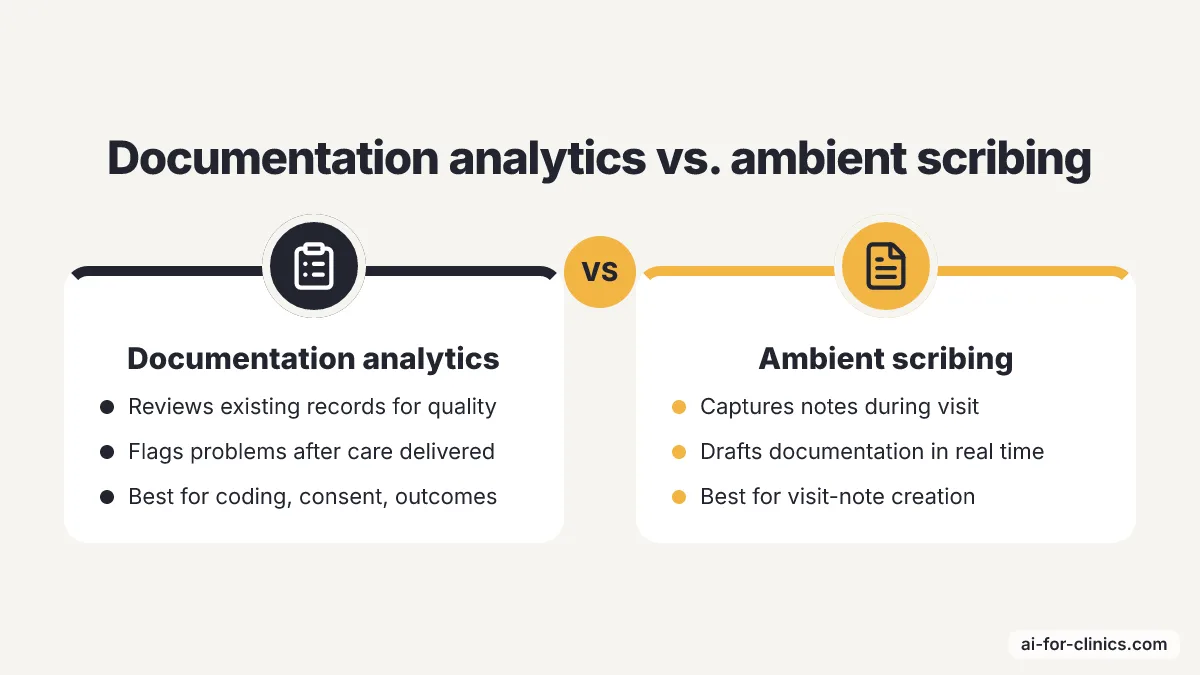
The diagram illustrates workflow distinctions, not verified capabilities or timing for every listed product. Read its category labels as a discussion aid, not as comparative evidence that a product is "best" for a task. Some proposed solutions may span categories; request a demonstration rather than infer their scope from the illustration.
A useful buying sequence is short and operational:
- Name the failure mode in plain language, such as missing documentation detail, poor consent capture, weak outcomes follow-up, coding errors, or conversion defects.
- Identify the record surface affected, such as clinician notes, consent forms, outcomes instruments, registry data, or converted charts.
- Assign the owner before the demo, because clinicians, revenue cycle leaders, compliance staff, and data teams will judge different analytics outputs.
- Ask the vendor to show the exception queue, reviewer workflow, and final action taken after the platform flags a problem.
- Reject any demo that cannot connect an analytic finding to a staff action, because dashboards that do not change documentation behavior become shelfware.
When should a clinic investigate ambient documentation instead?
Investigate ambient documentation when visit-note drafting, rather than review of existing documentation or data, is the named problem. Net Health's ambient documentation for wound care page describes WoundExpert documentation features, while Abridge's announcement describes a Northwestern Medicine implementation. These are useful references for a separate note-creation evaluation, not comparative evidence that the platforms in this article are interchangeable. Assess the products here by the documentation, records, consent, outcomes, conversion, or coding problem the clinic actually needs to investigate.
The exception is a clinic whose immediate requirement is live visit capture and draft note generation for clinician signature. That buyer should evaluate ambient documentation tools first, because a documentation analytics platform will not automatically solve the front-end note creation problem.
AI oversight is a question to include in procurement, even when the shortlisted vendor is not an ambient scribe. The linked release-notes reference previously labeled AI evaluation dashboard did not substantiate that specific dashboard claim during this review. Do not use it as evidence of a release date, access to evaluation results, or an industry-wide buying trend. Instead, ask each vendor what evaluation materials it can supply for the product being considered.
For a clinic comparing documentation analytics with an AI-enabled product, the oversight question should remain tied to the intended use. A buyer can ask what evaluation information is available and how the organization reviews it, while avoiding the assumption that a dashboard for one product establishes the oversight process for every vendor.
How should founders and investors compare these categories?
Founders and investors should compare companies by the documentation task and intended buyer, not by a broad "clinic documentation" label. AI for Clinics is Clinsight's directory of U.S. healthcare startups, and that directory lens is useful because a documentation improvement company, a consent documentation company, and a coding analytics company should not be benchmarked as direct substitutes unless they compete for the same budget owner.
That category distinction also makes a market map more useful. A founder assessing a competitor should compare products that solve the same documentation job and sell to the same decision-maker, rather than treating every platform connected to a medical record as a direct alternative.
Clinic operators comparing adjacent AI categories can widen the search after the documentation use case is settled. A broader Illinois clinic AI shortlist helps when the question extends beyond records into other clinic operations, while a primary care AI platform comparison is more useful when the buyer is not tied to documentation analytics alone.
Dental organizations should keep practice-partnership questions separate from documentation analytics procurement. The Accelerate Dental dentist owned partnership model reference could not be retrieved during this review, so this article does not rely on it to establish governance, services, or product capabilities. It is not evidence for ranking a documentation analytics platform, and any partnership terms would need separate verification before they informed a business decision.
A final procurement test is whether the buyer can describe the platform in one sentence without using the word "AI." If the sentence names a concrete workflow, such as coding error detection, electronic consent, outcomes capture, or health record conversion, the shortlist is probably disciplined enough for a serious demo.
The buyer can use that sentence to keep the demo focused: name the problem, the record or data involved, and the person expected to act on the result. If a vendor's explanation cannot be compared with that statement, the clinic should ask for a demonstration tied to its stated workflow rather than broaden the evaluation into a general technology review.
Choose documentation analytics by workflow, not the AI label
Start with one documentation failure that staff can recognize without a vendor present. Use a concrete requirement such as "coding errors from incomplete notes" or "consent forms disconnected from the record" to frame a healthcare document management evaluation. That gives vendors a workflow to demonstrate and gives the clinic a basis for comparing proposals, without promising that a category match alone will produce a better result.
The next step is to invite only the vendors whose public positioning matches that failure mode, then ask each one to show the path from flagged issue to corrected record. Investors and founders should run the same exercise as category mapping: the more precisely a company owns one documentation workflow, the easier it is to understand who buys it, who uses it, and which competitors belong in the same frame.
Editorial process note: This revision used AI assistance for structure, wording, and source checks. It is not a record of hands-on product testing or completed clinical or legal review. The publisher remains responsible for human editorial verification before release.
Frequently Asked Questions
Which health tech analytics platforms does the article cover for Illinois clinics?
The article covers Clinical Data Intelligence’s ACRADO, Veradigm, PatientIQ, Two Point, ConsentMD, and Context⁴ Healthcare. Their linked materials concern documentation improvement, clinical data registries, patient-reported outcomes, conversion quality analysis, consent workflows, and coding-error identification, respectively. Match the specific product to the clinic’s intended workflow and users. Inclusion does not establish outpatient suitability, implementation success, or comparative performance, and the products should not be treated as interchangeable.
How should an Illinois clinic choose a documentation analytics platform?
Start by identifying the specific documentation problem, such as note quality, record-level reporting, patient outcomes, conversion quality, or consent workflow. Then define who will review the platform’s findings and what action they should take. For a demo, bring examples or a reporting question from the clinic’s work and check whether the platform addresses that need. The article advises evaluating the intended job, not assuming one tool covers every use.
Which platform focuses on patient outcomes, and which addresses electronic consent?
PatientIQ emphasizes patient-reported outcomes, while ConsentMD describes consent, documentation, and workflow management. Ask PatientIQ how the proposed outcomes workflow connects to the clinic’s visits or procedures. Ask ConsentMD to demonstrate how signed information reaches the clinical record; the cited material does not establish automatic structured-chart integration. Evaluate each proposed product against the clinic’s intended use rather than inferring capabilities from its category.
Does Veradigm replace a clinic’s medical record system?
The linked Veradigm registry page does not establish that the proposed offering replaces a clinic’s record system. It describes clinical data registries for a life-sciences audience, so clinic buyers should identify the specific product, intended users, available data, and reporting purpose. Bring a reporting question to the demo and confirm what the proposal includes instead of inferring operational documentation features from the broader company name.
Which platform can help check health record conversion quality?
Two Point’s published conversion workflow includes quality analysis of converted data. Ask the vendor to demonstrate that process with an approved representative sample, explain how defects are found, and identify who reviews reports and resolves discrepancies. Decide what reconciliation evidence the clinic needs before approving a transfer. The cited conversion page is not enough to establish the inclusion or exclusion of ongoing coding, documentation-review, or outcomes services.
Related reading
- Top 6 Artificial Intelligence Solutions for Illinois Clinics
- Top Artificial Intelligence Platforms for Primary Care Clinics
- Fundraising Readiness: Key Steps for Health-Tech Startups
- 2026 Strategies for Rapid User Growth in Healthcare Tech
- Choose AI Platforms by Clinic Need: Records, Quoting, Marketing, Hiring